
parallel circuits
11th Grade
•10 Qs

Similar activities
Momentum and Collisions
11th Grade
•15 Qs
3.01, 3.02, & 3.03 Waves
9th - 12th Grade
•10 Qs
Term 4 Review
11th Grade
•12 Qs
Diode
11th - 12th Grade
•15 Qs
A1 Data definitions
9th - 12th Grade
•12 Qs
Energy stores and Transfers- Self learning
9th - 11th Grade
•12 Qs
7.1.d protons v neutron graph, half life
11th - 12th Grade
•11 Qs
Electrical Systems - Conductors & Insulators
KG - University
•10 Qs

parallel circuits

Quiz
•
Physics
•
11th Grade
•
Medium

Sarah Mcdonald
Used 2+ times
FREE Resource

Enhance your content in a minute
10 questions
Show all answers
1.
MULTIPLE CHOICE QUESTION
10 mins • 1 pt

What will happen if one light bulb is removed from this circuit?
2.
MULTIPLE CHOICE QUESTION
10 mins • 1 pt
Does this statement best describe a parallel or a series circuit.
When more light bulbs are added they all remain bright.
3.
MULTIPLE CHOICE QUESTION
10 mins • 1 pt
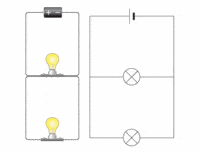
What kind of circuit is this?
4.
MULTIPLE CHOICE QUESTION
10 mins • 1 pt
In a parallel circuit which of the following is the same value throughout the circuit?
5.
MULTIPLE CHOICE QUESTION
10 mins • 1 pt

The total resistance of this circuit is
6.
MULTIPLE CHOICE QUESTION
10 mins • 1 pt
What is a benefit of using a parallel circuit?
7.
MULTIPLE CHOICE QUESTION
10 mins • 1 pt
When unequal resistors are connected in parallel in a circuit,
the same current always runs through each resistor.
the potential drop is always the same across each resistor.
the largest resistance has the largest current through it.
the power generated in each resistor is the same.

Access all questions and much more by creating a free account
Create resources
Host any resource
Get auto-graded reports

Continue with Google

Continue with Email

Continue with Classlink

Continue with Clever
or continue with

Microsoft
%20(1).png)
Apple

Others
Already have an account?
Similar Resources on Wayground
10 questions
The Physical World
Quiz
•
11th Grade
15 questions
Asah Otak 2
Quiz
•
11th - 12th Grade
10 questions
Form 4 CHp 3.2 Pressure In Liquids
Quiz
•
KG - University
15 questions
Simple Electric Motor and Generator
Quiz
•
7th Grade - University
15 questions
HS DO NOW Lab on Refraction
Quiz
•
9th - 12th Grade
10 questions
Materials: Hooke's Law
Quiz
•
11th Grade
11 questions
Linear Motion
Quiz
•
11th Grade
10 questions
Electrical Systems - Conductors & Insulators
Quiz
•
KG - University
Popular Resources on Wayground
15 questions
Fractions on a Number Line
Quiz
•
3rd Grade
20 questions
Equivalent Fractions
Quiz
•
3rd Grade
25 questions
Multiplication Facts
Quiz
•
5th Grade
22 questions
fractions
Quiz
•
3rd Grade
20 questions
Main Idea and Details
Quiz
•
5th Grade
20 questions
Context Clues
Quiz
•
6th Grade
15 questions
Equivalent Fractions
Quiz
•
4th Grade
20 questions
Figurative Language Review
Quiz
•
6th Grade
Discover more resources for Physics
18 questions
Universal Law of Gravitation

Lesson
•
11th Grade
20 questions
Potential and Kinetic Energy
Quiz
•
9th - 12th Grade
34 questions
Energy Review
Quiz
•
9th - 12th Grade
14 questions
Bill Nye Waves

Interactive video
•
9th - 12th Grade
24 questions
Reflection, Refraction & Diffraction
Quiz
•
6th - 12th Grade