
Energy, Work and Power
Authored by Ain Nomura
Science, Physics
7th - 9th Grade
NGSS covered
Used 470+ times


AI Actions
Add similar questions
Adjust reading levels
Convert to real-world scenario
Translate activity
More...
Content View
Student View
33 questions
Show all answers
1.
MULTIPLE CHOICE QUESTION
2 mins • 5 pts
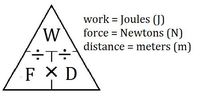
A weightlifter lifts two 300 newton weights 1.5 meters off the ground. How much work has she done?
Work = Force x Distance
600 J
450 J
900 J
1200 J
2.
MULTIPLE CHOICE QUESTION
2 mins • 1 pt
Simple machines make work easier by increasing what?
3.
MULTIPLE CHOICE QUESTION
15 mins • 1 pt
The amount by which a machine multiplies input force is known as the
4.
MULTIPLE CHOICE QUESTION
2 mins • 5 pts

You do 90 joules of work in 30 seconds. How much power have you generated?
Power = Work/time
5.
MULTIPLE CHOICE QUESTION
2 mins • 5 pts

You move a 8 N object five meters in 4 seconds. How much power have you generated?
Work = Force x Distance
Power = Work/Time
160 watts
10 watts
6.4 watts
17 watts
Answer explanation
Work(40J) = Force(0.8N) x Distance(5m)
Power(10W) = Work(40J) / Time(4s)
Tags
NGSS.HS-PS3-2
6.
MULTIPLE CHOICE QUESTION
2 mins • 1 pt

When you rub your hands together on a cold day, you use friction to convert
Mechanical energy into thermal energy
Thermal energy into nuclear energy
Chemical energy into mechanical energy.
Electrical energy into thermal energy
Tags
NGSS.MS-PS3-3
NGSS.MS-PS3-4
NGSS.MS-PS3-5
7.
MULTIPLE CHOICE QUESTION
2 mins • 1 pt
Which energy-conversion chain occurs whenever coal is burned to create steam to spin the generator at a power station?
chemical to mechanical to potential
thermal to chemical to mechanical to electrical
chemical to thermal to mechanical to electrical
chemical to chemical to mechanical to radiant
Answer explanation
Water changing to steam does not break any molecular bonds, mechanical energy is harnessed as pressure from the expanded volume of steam
Tags
NGSS.HS-PS3-3
Access all questions and much more by creating a free account
Create resources
Host any resource
Get auto-graded reports

Continue with Google

Continue with Email

Continue with Classlink

Continue with Clever
or continue with

Microsoft
%20(1).png)
Apple

Others
Already have an account?



