
CGLTP Practice
6th Grade
•71 Qs

Similar activities
Reinos
6th Grade
•74 Qs
Practice for Chapter 1 Quiz Ecology
6th - 8th Grade
•75 Qs
Magnets and Circuits Review
6th - 8th Grade
•70 Qs
Fall Semester Vocabulary 2024
6th Grade
•73 Qs
Tides and Seasons
6th Grade
•76 Qs
Air Pressure and Temperature Concepts
6th Grade
•72 Qs
Solar System
6th Grade
•73 Qs
CBA 2 Review
6th - 8th Grade
•70 Qs

CGLTP Practice

Quiz
•
Science
•
6th Grade
•
Hard

Maddison Tate
Used 2+ times
FREE Resource

Enhance your content in a minute
71 questions
Show all answers
1.
MULTIPLE CHOICE QUESTION
5 mins • 1 pt
A chemical change is different than a physical change because in a chemical change
chemicals are used
molecules do not physically touch
a new substance is formed and in a physical no new substance is formed
the change can be seen but in a physical change it cannot
2.
MULTIPLE SELECT QUESTION
5 mins • 1 pt
Which of the following 2 are chemical reactions?
sugar dissolving in water
water turning into steam
burning wood
mixing baking soda and vinegar
tearing paper
3.
MULTIPLE CHOICE QUESTION
30 sec • 1 pt
Which of the following examples shows that a chemical reaction has occurred?
4.
MULTIPLE CHOICE QUESTION
30 sec • 1 pt
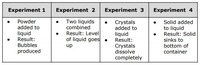
Four students performed four different investigations by combining different substances. Their results are shown in the table provided. In which experiment are new substances being formed?
5.
MULTIPLE CHOICE QUESTION
30 sec • 1 pt
A clear liquid from a flask is poured into another clear liquid in a beaker. Which of the following results of this procedure would indicate a new substance was formed?
6.
MULTIPLE CHOICE QUESTION
2 mins • 1 pt
Which of the following is an example that includes evidence of a chemical reaction?
7.
MULTIPLE CHOICE QUESTION
2 mins • 1 pt
Evidence of a chemical reactions is anything that shows -
Access all questions and much more by creating a free account
Create resources
Host any resource
Get auto-graded reports

Continue with Google

Continue with Email

Continue with Classlink

Continue with Clever
or continue with

Microsoft
%20(1).png)
Apple

Others
Already have an account?
Similar Resources on Wayground
71 questions
Thermal Energy
Quiz
•
6th Grade
67 questions
B4 AQA Bioenergetics
Quiz
•
KG - 12th Grade
70 questions
Science Final Exam 2023
Quiz
•
6th Grade
75 questions
Energy and Energy Transformations
Quiz
•
6th - 8th Grade
67 questions
Thermal Energy and Heat Transfer
Quiz
•
6th Grade
72 questions
World Land Biome Review
Quiz
•
6th - 8th Grade
70 questions
PMA 3 Review
Quiz
•
6th Grade
70 questions
Respiratory System
Quiz
•
6th - 9th Grade
Popular Resources on Wayground
15 questions
Fractions on a Number Line
Quiz
•
3rd Grade
20 questions
Equivalent Fractions
Quiz
•
3rd Grade
25 questions
Multiplication Facts
Quiz
•
5th Grade
54 questions
Analyzing Line Graphs & Tables
Quiz
•
4th Grade
22 questions
fractions
Quiz
•
3rd Grade
20 questions
Main Idea and Details
Quiz
•
5th Grade
20 questions
Context Clues
Quiz
•
6th Grade
15 questions
Equivalent Fractions
Quiz
•
4th Grade
Discover more resources for Science
20 questions
Cell Organelles and Functions
Quiz
•
6th - 8th Grade
33 questions
Grade 6 Quarter 3 PMA 5 Review
Quiz
•
6th - 8th Grade
20 questions
Rocks and The Rock Cycle
Quiz
•
6th Grade
20 questions
Thermal Energy - Heat Transfer
Quiz
•
6th Grade
10 questions
Exploring the Rock Cycle: Types and Formation

Interactive video
•
6th - 8th Grade
10 questions
Exploring the Layers of the Earth
Interactive video
•
6th - 10th Grade
15 questions
Punnett Squares
Quiz
•
6th Grade
10 questions
Exploring the Rock Cycle
Interactive video
•
6th - 8th Grade