
APES Survivorship Curves
Authored by Megan Brewczynski
Science
11th - 12th Grade
NGSS covered
Used 10+ times


AI Actions
Add similar questions
Adjust reading levels
Convert to real-world scenario
Translate activity
More...
Content View
Student View
22 questions
Show all answers
1.
MULTIPLE CHOICE QUESTION
15 mins • 1 pt
An r-selected species characteristically has
2.
MULTIPLE CHOICE QUESTION
30 sec • 1 pt

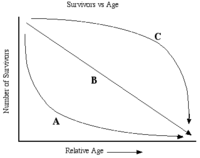
Tracks organisms that tend to live long lives (low death rate and high survivorship rate); toward the end of their life expectancies, however, there is a dramatic increase in the death rate.
Type I
Type II
Type III
Type IV
3.
MULTIPLE CHOICE QUESTION
30 sec • 1 pt
Describes organisms with a high death rate (or low survivorship rate) immediately following birth. Examples include bacteria, fishes, and invertebrates.
Type I
Type II
Type III
Type IV
4.
MULTIPLE CHOICE QUESTION
30 sec • 1 pt
These organisms typically live in unstable, unpredictable environments & are able to reproduce rapidly (exponentially). They do not take care of their young & are subject to predation.
k-strategist
r-strategist
m-strategist
s-strategist
5.
MULTIPLE CHOICE QUESTION
30 sec • 1 pt
These organisms occupy stable environments, are larger in size and have longer life expectancies. They produce, during their life spans, fewer offspring, but place a greater investment in each.
k-strategist
r-strategist
m-strategist
s-strategist
Tags
NGSS.HS-LS2-6
6.
MULTIPLE CHOICE QUESTION
30 sec • 1 pt
To measure population density, you must divide the number of individuals living in a defined space by the
7.
MULTIPLE CHOICE QUESTION
2 mins • 1 pt
A species described as r-strategist would definitely NOT have which of the following characteristics?

Access all questions and much more by creating a free account
Create resources
Host any resource
Get auto-graded reports

Continue with Google

Continue with Email

Continue with Classlink

Continue with Clever
or continue with

Microsoft
%20(1).png)
Apple

Others
Already have an account?
Similar Resources on Wayground

17 questions
2nd Summative Test

Quiz
•
12th Grade
20 questions
Tamkeen Science Exam Revision
Quiz
•
9th - 12th Grade
19 questions
Elba Environmental Science Chapter 1
Quiz
•
12th Grade
17 questions
Energy Resources
Quiz
•
9th - 12th Grade
20 questions
Plant and Animal Cell Test
Quiz
•
5th Grade - University
19 questions
Earthquake destruction and Occurence
Quiz
•
12th Grade
20 questions
Electromagnet and Its Strength
Quiz
•
8th Grade - University
19 questions
HISTORY OF LIFE ON EARTH QUIZ
Quiz
•
11th Grade
Popular Resources on Wayground
15 questions
Fractions on a Number Line
Quiz
•
3rd Grade
20 questions
Equivalent Fractions
Quiz
•
3rd Grade
25 questions
Multiplication Facts
Quiz
•
5th Grade
22 questions
fractions
Quiz
•
3rd Grade
20 questions
Main Idea and Details
Quiz
•
5th Grade
20 questions
Context Clues
Quiz
•
6th Grade
15 questions
Equivalent Fractions
Quiz
•
4th Grade
20 questions
Figurative Language Review
Quiz
•
6th Grade
Discover more resources for Science
14 questions
Natural Selection and Adaptation

Lesson
•
9th - 12th Grade
38 questions
Water Cycle and Groundwater
Quiz
•
9th - 12th Grade
12 questions
Cell Organelles and Their Functions
Lesson
•
9th - 12th Grade
12 questions
Homeostasis: Positive and Negative Feedback Loops

Interactive video
•
11th Grade
13 questions
Amoeba Sisters: Biomolecules
Interactive video
•
9th - 12th Grade
25 questions
APES Unit 6 Review
Quiz
•
12th Grade
60 questions
2025 Genetics Test Study Guide
Quiz
•
9th - 12th Grade
10 questions
Understand Cell Functions and Organelles
Quiz
•
9th - 12th Grade