
Hook's Law and Elastic Potential Energy
Authored by Nathaniel Session
Physics, Science
12th Grade
NGSS covered
Used 38+ times


AI Actions
Add similar questions
Adjust reading levels
Convert to real-world scenario
Translate activity
More...
Content View
Student View
26 questions
Show all answers
1.
MULTIPLE CHOICE QUESTION
30 sec • 1 pt
What is potential energy?
The energy an object has due to its position or condition.
The energy an object has due to its motion.
The energy an object has due to its chemical composition.
The energy as object has due to its atomic structure.
Tags
NGSS.HS-PS2-4
2.
MULTIPLE CHOICE QUESTION
30 sec • 1 pt

Which type of potential energy causes the arrow to shoot from the bow?
Tags
NGSS.MS-PS3-2
3.
MULTIPLE CHOICE QUESTION
1 min • 1 pt

The diagram shows the same spring being stretched at different lengths using different masses. At which length does the spring have the MOST potential energy?
length A
length B
length C
length D
Tags
NGSS.HS-PS3-2
4.
MULTIPLE CHOICE QUESTION
30 sec • 1 pt
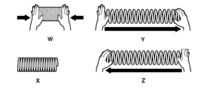
Elastic potential energy is energy stored in an object, such as a spring, due to the object being stretched or compressed. In which position is it most likely that the spring has lost its elastic potential energy?
W
Y
X
Z
Tags
NGSS.MS-PS3-5
5.
MULTIPLE SELECT QUESTION
1 min • 1 pt
SELECT ALL POSTITIONS where the spring has STORED ELASTIC ENERGY
W
Y
X
Z
Tags
NGSS.MS-PS3-2
6.
MULTIPLE CHOICE QUESTION
30 sec • 1 pt

Elastic Potential Energy is _____________________________________.
the ability of a material to return to its original shape after it has been stretched or deformed.
potential energy that is stored due to the deformation of an elastic object, such as a stretched spring.
energy stored in the bonds of chemical compounds. Chemical energy is released during chemical reactions.
the energy contained within a system that is responsible for its temperature.
the flow of thermal energy.
Tags
NGSS.MS-PS3-2
7.
MULTIPLE CHOICE QUESTION
30 sec • 1 pt
If F is force, k is spring constant and x is extension, Hooke's Law tells us that:
Access all questions and much more by creating a free account
Create resources
Host any resource
Get auto-graded reports

Continue with Google

Continue with Email

Continue with Classlink

Continue with Clever
or continue with

Microsoft
%20(1).png)
Apple

Others
Already have an account?


