
Natural Selection Interim Review
Authored by GIVE West
Biology
9th Grade
Used 1+ times


AI Actions
Add similar questions
Adjust reading levels
Convert to real-world scenario
Translate activity
More...
Content View
Student View
26 questions
Show all answers
1.
MULTIPLE CHOICE QUESTION
30 sec • 1 pt
Why are advantageous traits more likely to be passed onto offspring?
Because they are more likely to survive and reproduce.
Because they come from dominant alleles.
Because they come from recessive alleles.
Because the organism knew it needed that trait, survives, and passes it on.
2.
MULTIPLE CHOICE QUESTION
30 sec • 1 pt
The differences among a species, like different bird beaks, are called
3.
MULTIPLE CHOICE QUESTION
30 sec • 1 pt
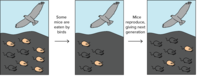
Why is the mouse population changing over time?
4.
MULTIPLE CHOICE QUESTION
30 sec • 1 pt

What process is being shown in this image?
5.
MULTIPLE CHOICE QUESTION
30 sec • 1 pt
Where do adaptations come from?
The individual organism decides to adapt
Mutations that give an organism an advantage in its environment
Genetic recombination during meiosis
Both mutations and genetic recombination are sources of adaptation
6.
MULTIPLE CHOICE QUESTION
30 sec • 1 pt
"Organisms that are better adapted to the environment survive to pass traits to their offspring" is the definition of
Natural Selection
Evolution
Selective Breeding
Artificial Selection
7.
MULTIPLE CHOICE QUESTION
30 sec • 1 pt
Which best describes the role of mutations in natural selection?
Mutations help an organism to better survive in their environment
An organism may acquire a helpful mutation by interacting with the environment
A mutation may result in a beneficial trait that makes an organism more likely to survive and reproduce
Organisms with certain traits are more likely to win competitions for mutations

Access all questions and much more by creating a free account
Create resources
Host any resource
Get auto-graded reports

Continue with Google

Continue with Email

Continue with Classlink

Continue with Clever
or continue with

Microsoft
%20(1).png)
Apple

Others
Already have an account?
Similar Resources on Wayground

25 questions
Endocrine Disorders

Quiz
•
KG - University
27 questions
Steele HS Biology Blitz Category 2
Quiz
•
9th Grade
27 questions
Anatomy Identification Test
Quiz
•
9th - 12th Grade
22 questions
Evolution and Natural Selection
Quiz
•
8th - 10th Grade
21 questions
Academic Genetics Vocabulary Quiz Practice
Quiz
•
9th - 10th Grade
21 questions
Biomolecules: Function
Quiz
•
9th - 11th Grade
21 questions
Organization and Two Cell Types
Quiz
•
9th Grade
24 questions
Biological Molecules
Quiz
•
8th - 10th Grade
Popular Resources on Wayground
15 questions
Fractions on a Number Line
Quiz
•
3rd Grade
10 questions
Probability Practice
Quiz
•
4th Grade
15 questions
Probability on Number LIne
Quiz
•
4th Grade
20 questions
Equivalent Fractions
Quiz
•
3rd Grade
25 questions
Multiplication Facts
Quiz
•
5th Grade
22 questions
fractions
Quiz
•
3rd Grade
6 questions
Appropriate Chromebook Usage

Lesson
•
7th Grade
10 questions
Greek Bases tele and phon
Quiz
•
6th - 8th Grade
Discover more resources for Biology
22 questions
Human Body Systems Overview
Quiz
•
9th Grade
25 questions
photosynthesis and cellular respiration
Quiz
•
9th Grade
18 questions
Enzymes and Their Functions Quiz
Quiz
•
9th Grade
20 questions
Food Chains and Food Webs
Quiz
•
7th - 12th Grade
30 questions
Exploring the World of Plants
Quiz
•
9th Grade
65 questions
Review for TEST 1
Quiz
•
9th - 10th Grade
10 questions
Exploring Food Webs and Energy Pyramids

Interactive video
•
6th - 10th Grade
20 questions
Meiosis and Sexual Reproduction
Quiz
•
9th Grade