
Q1 Chem Review "Gases"
Authored by Matthew Martino
Chemistry
9th - 12th Grade
NGSS covered
Used 3+ times


AI Actions
Add similar questions
Adjust reading levels
Convert to real-world scenario
Translate activity
More...
Content View
Student View
8 questions
Show all answers
1.
MULTIPLE CHOICE QUESTION
45 sec • 1 pt

According to Boyle's Law, the pressure and volume of a gas have _____ relationship.
an Inverse
a Direct
Answer explanation

Unlike the direct relationships of volume vs temperature, and pressure vs temperature...
pressure and volume change opposite of each other.
If volume is decreased, pressure is increased.
if volume is increased, pressure is decreased.
2.
MULTIPLE CHOICE QUESTION
1 min • 1 pt

The following graph of the direct relationship between volume and temperature suggests that heating a gas (*under constant pressure*) will cause _______ in volume
a decrease
an increase
Answer explanation
a direct relationship (seen on a graph as a straight, upward trending line...)
means that as one variable increases, the other also increases.
and vice versa.
If one decreases, the other decreases too.
3.
MULTIPLE CHOICE QUESTION
1 min • 1 pt
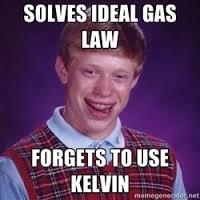
In order to convert to Kelvin, you ___ ______ to the Celsius measurement.
(hint... this formula is on the back of your Reference Tables)
add 100
add 273
subtract 273
divide by 273
subtract 100
4.
MULTIPLE CHOICE QUESTION
1 min • 1 pt

Suppose each balloon in the image is the same volume but contained a different type of gas molecule (H2 in one balloon, CO2 in another, and so on...)
What must be true about the number of moles of gas in each balloon?
They are the same
The lighter gases have more moles in their balloon
The heavier gases have more moles in their balloon
Answer explanation
This is called Avogradro's Law.
Equal moles of gases at the same temperature and experiencing the same external pressure will occupy the same volume REGARDLESS of the identity of the gases.
For example...
at STP, 1 mole of any gas occupies 22.4 Liters of volume.
Tags
NGSS.HS-PS1-7
5.
MULTIPLE CHOICE QUESTION
2 mins • 1 pt
Gases have...
A definite shape and a definite volume
No definite shape nor volume
Answer explanation
this relates to kinetic molecular theory of gases
gas particles have large amounts of space between them and feel relatively no attractive forces for each other.
gases fill their container entirely and apply pressure to its walls equally.
6.
MULTIPLE CHOICE QUESTION
5 mins • 1 pt

If I have 5.6 liters of gas in a piston at a pressure of 1.5 atm and compress the gas until it has a new volume is 4.8 L, what will the new pressure inside the piston be?
(assume T1 and T2 are the same because it is held constant)
7.
MULTIPLE CHOICE QUESTION
5 mins • 1 pt
A sample of gas is at 300 K and initial volume of 2.5 L. If the temperature is cooled down to 200 K, what will the new volume be?
(assume P1 and P2 are the same because it is held constant.. notice its not mentioned in the problem)
1.7 L
3.75 L
0.6 L
24000 L


Access all questions and much more by creating a free account
Create resources
Host any resource
Get auto-graded reports

Continue with Google

Continue with Email

Continue with Classlink

Continue with Clever
or continue with

Microsoft
%20(1).png)
Apple

Others
Already have an account?

