
Periodic Table WebQuest
Authored by Kyle Cook
Chemistry, Science
8th - 12th Grade
NGSS covered
Used 62+ times


AI Actions
Add similar questions
Adjust reading levels
Convert to real-world scenario
Translate activity
More...
About
This quiz comprehensively covers the organization and classification of the periodic table of elements, targeting students in grades 8-12 studying introductory chemistry. The questions assess fundamental understanding of periodic table structure, including the distinction between groups (vertical columns) and periods (horizontal rows), and how elements are arranged by atomic number. Students must demonstrate knowledge of major element families such as alkali metals, alkaline earth metals, halogens, noble gases, transition metals, and metalloids, along with their characteristic properties and reactivity patterns. The quiz requires mastery of valence electron concepts, understanding that elements in the same group share similar chemical properties due to identical numbers of valence electrons, and the ability to locate specific elements using period and group coordinates. Students also need to identify basic atomic structure components like atomic number, chemical symbols, and atomic mass, while understanding how electron configuration drives chemical behavior and bonding patterns. Created by Kyle Cook, a Chemistry teacher in the US who teaches grades 8-12. This quiz serves as an excellent formative assessment tool for students learning periodic table fundamentals, functioning effectively as a comprehensive review before unit tests or as structured practice following initial instruction on atomic theory and periodic trends. The varied question formats, from multiple choice to fill-in-the-blank responses, accommodate different learning styles while reinforcing key vocabulary and conceptual connections. Teachers can utilize this as a warmup activity to activate prior knowledge, assign it as homework to reinforce classroom learning, or implement it as a guided practice session during computer lab time. The webquest format encourages independent exploration while maintaining focus on essential learning objectives. This assessment aligns with NGSS standards HS-PS1-1 (periodic table organization) and MS-PS1-1 (atomic structure), along with supporting Common Core mathematical practices through logical reasoning and pattern recognition skills essential for understanding periodic trends and element classification systems.
Content View
Student View
68 questions
Show all answers
1.
MULTIPLE CHOICE QUESTION
30 sec • 1 pt
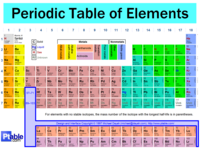
The vertical (up and down) columns in the Periodic Table are called
groups
towers
periods
atomic numbers
2.
FILL IN THE BLANK QUESTION
1 min • 1 pt
The vertical (up and down) columns in the Periodic Table are called
3.
MULTIPLE CHOICE QUESTION
30 sec • 1 pt
The Modern Periodic Table of Elements is arranged by
4.
MULTIPLE CHOICE QUESTION
30 sec • 1 pt
Which group of the periodic table is composed of inert (not reactive) gases?
5.
MULTIPLE CHOICE QUESTION
30 sec • 1 pt
Which is an alkali metal?
6.
MULTIPLE CHOICE QUESTION
30 sec • 1 pt
Which is a halogen?
7.
MULTIPLE CHOICE QUESTION
30 sec • 1 pt
Elements in a ..................have similar chemical properties.


Access all questions and much more by creating a free account
Create resources
Host any resource
Get auto-graded reports

Continue with Google

Continue with Email

Continue with Classlink

Continue with Clever
or continue with

Microsoft
%20(1).png)
Apple

Others
Already have an account?
Similar Resources on Wayground

66 questions
Chemical Bonds

Quiz
•
8th - 9th Grade
65 questions
Space Unit Evaluation (1D)
Quiz
•
9th Grade
65 questions
APES Unit 1 Review
Quiz
•
9th Grade
64 questions
Senior Physics Year A Review
Quiz
•
11th - 12th Grade
70 questions
Lewis Dot Structures
Quiz
•
10th - 12th Grade
65 questions
8th Grade - Measurement
Quiz
•
6th - 9th Grade
67 questions
Macromolecules and Cells
Quiz
•
7th - 8th Grade
65 questions
TWHS Unit 5 review
Quiz
•
9th - 12th Grade
Popular Resources on Wayground
15 questions
Fractions on a Number Line
Quiz
•
3rd Grade
10 questions
Probability Practice
Quiz
•
4th Grade
15 questions
Probability on Number LIne
Quiz
•
4th Grade
20 questions
Equivalent Fractions
Quiz
•
3rd Grade
25 questions
Multiplication Facts
Quiz
•
5th Grade
22 questions
fractions
Quiz
•
3rd Grade
6 questions
Appropriate Chromebook Usage

Lesson
•
7th Grade
10 questions
Greek Bases tele and phon
Quiz
•
6th - 8th Grade
Discover more resources for Chemistry
20 questions
Predicting Products
Quiz
•
9th - 12th Grade
11 questions
Balancing Chemical Equations
Lesson
•
9th Grade
10 questions
Exploring Types of Chemical Reactions

Interactive video
•
6th - 10th Grade
19 questions
Stoichiometry, % yield, Limiting Reactants
Quiz
•
10th Grade
20 questions
Types of Chemical Reactions
Quiz
•
9th - 12th Grade
10 questions
Exploring Ionic and Covalent Bonding Concepts
Interactive video
•
6th - 10th Grade
7 questions
GCSE Chemistry - Balancing Chemical Equations #4
Interactive video
•
9th - 10th Grade
24 questions
Unit 2 (Part 1) Bonding Review
Quiz
•
12th Grade