
AASL: Kinematics with Calculus
Authored by Anonymous Anonymous
Physics
11th Grade
Used 1+ times


AI Actions
Add similar questions
Adjust reading levels
Convert to real-world scenario
Translate activity
More...
Content View
Student View
11 questions
Show all answers
1.
MULTIPLE CHOICE QUESTION
1 min • 1 pt

Motion sensors recorded the following data about a runner during a cross-country race. During which segment of the race did the runner have the greatest speed?
2.
MULTIPLE CHOICE QUESTION
1 min • 1 pt
What is the acceleration of an object moving at constant velocity?
2 m/s2
1 m/s2
0 m/s2
0.8 m/s2
3.
MULTIPLE CHOICE QUESTION
1 min • 1 pt

The graph shows the position of a truck vs. time. According to the graph, the velocity of the truck is...
increasing
remaining constant
decreasing
4.
MULTIPLE CHOICE QUESTION
1 min • 1 pt
You toss a ball straight upward, in the positive direction. The ball falls freely under the influence of gravity.
At the highest point in the ball’s motion,
its velocity is zero and its acceleration is zero.
its velocity is zero and its acceleration is positive (upward).
its velocity is zero and its acceleration is negative (downward).
its velocity is positive (upward) and its acceleration is zero.
its velocity is positive (upward) and its acceleration is zero.
5.
MULTIPLE CHOICE QUESTION
1 min • 1 pt
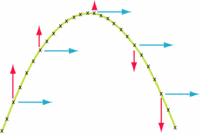
What is the vertical acceleration of a projectile at any given point in its trajectory?
0 m/s2
-9.81 m/s2
6.
MULTIPLE CHOICE QUESTION
1 min • 1 pt
The position of an object is given by the equation x = 3.0 t2 + 1.5 t + 4.5, where x is in meters and t is in seconds. What is the instantaneous acceleration of the object at t = 3.0 s?
3.0 m/s/s
6.0 m/s/s
9.0 m/s/s
19.5 m/s/s
36 m/s/s
7.
MULTIPLE CHOICE QUESTION
1 min • 1 pt
If the position function for a particle is s(t) = -t2 - t, what is the instantaneous velocity function for the particle?
Access all questions and much more by creating a free account
Create resources
Host any resource
Get auto-graded reports

Continue with Google

Continue with Email

Continue with Classlink

Continue with Clever
or continue with

Microsoft
%20(1).png)
Apple

Others
Already have an account?



