
DNA Ex 1 and 2 Review
Authored by Michelle Bibel
Biology
9th Grade
NGSS covered
Used 5+ times


AI Actions
Add similar questions
Adjust reading levels
Convert to real-world scenario
Translate activity
More...
Content View
Student View
41 questions
Show all answers
1.
MULTIPLE CHOICE QUESTION
30 sec • 5 pts

The picture below shows an enzyme unwinding and unzipping DNA.
What is the name of this enzyme?
DNA Helicase
DNA Ligase
DNA polyermase
RNA Polymerase
2.
MULTIPLE SELECT QUESTION
30 sec • 5 pts
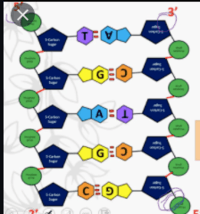
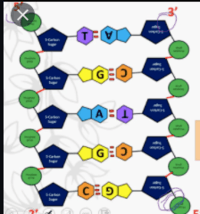
Which of the following DNA nucleotides are paired with the correct corresponding DNA nucleotide? (mark all that apply)
Adenine with Thymine
Guanine with Cytosine
Thymine with Cytosine
Adenine with Uracil.
Uracil with Thymine
3.
MULTIPLE CHOICE QUESTION
30 sec • 5 pts
Which is the role of DNA polymerase?
Unwinds the original DNA strand
Lays down RNA primer for new nucleotide bases.
Builds new strands by bringing in new nucleotide bases.
Remove Okazaki fragments for new nucleotides.
4.
MULTIPLE CHOICE QUESTION
1 min • 5 pts

Nitrogenous bases are joined by which type of bond?
Tags
NGSS.HS-LS1-1
5.
MULTIPLE CHOICE QUESTION
30 sec • 5 pts
Why does DNA replicate?
6.
MULTIPLE CHOICE QUESTION
2 mins • 5 pts
The process of DNA replication is called semi conservative because it results in
7.
MULTIPLE CHOICE QUESTION
30 sec • 5 pts
A process in which DNA has the unique ability to make an exact copy of itself.
Access all questions and much more by creating a free account
Create resources
Host any resource
Get auto-graded reports

Continue with Google

Continue with Email

Continue with Classlink

Continue with Clever
or continue with

Microsoft
%20(1).png)
Apple

Others
Already have an account?

