
Evolution Test Preparation Quiz
10th Grade
•28 Qs

Similar activities
Mendelian Genetics Review!
9th - 10th Grade
•25 Qs
Biology Revision
10th Grade
•23 Qs
Skeletal System
9th - 12th Grade
•23 Qs
Appendicular skeleton
9th Grade - University
•23 Qs
NERVOUS SYSTEM PRACTICE QUESTION
10th Grade
•23 Qs
Unit 5 Exam Review
10th - 12th Grade
•24 Qs
Macromolecules
9th - 12th Grade
•25 Qs
Einstein Bee (Final Round)
10th - 12th Grade
•24 Qs

Evolution Test Preparation Quiz

Quiz
•
Biology
•
10th Grade
•
Medium

Patricia Fettinger
Used 7+ times
FREE Resource

Enhance your content in a minute
28 questions
Show all answers
1.
MULTIPLE CHOICE QUESTION
2 mins • 1 pt

The environment around Manchester, England, changed during the Industrial Revolution. How did this change affect peppered moths living in the area?
Natural selection favored moths with dark wings because predators could not see them on the soot-colored trees.
Natural selection favored moths with white wings that were easy for predators to see.
Natural selection favored moths with white wings because predators could not see them on the soot-colored trees.
Natural selection caused moths with white wings to become extinct.
2.
MULTIPLE SELECT QUESTION
2 mins • 1 pt
SELECT ALL THAT APPLY: Which of the following must be true in order for organisms to be considered the same species?
They must be able to mate
They must be able to produce viable offspring
They must have structural similaries
They must have the same bone structure
3.
MULTIPLE CHOICE QUESTION
2 mins • 1 pt
Archeabacteria...
4.
MULTIPLE CHOICE QUESTION
45 sec • 1 pt
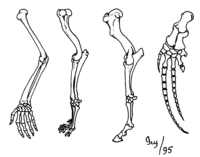
Structures with the same parts have different functions; suggests that organisms share a common ancestry
5.
MULTIPLE CHOICE QUESTION
1 min • 1 pt

Two organisms that are closely related would have
6.
MULTIPLE CHOICE QUESTION
1 min • 1 pt
What does Darwin's theory of evolution suggest?
7.
MULTIPLE CHOICE QUESTION
30 sec • 1 pt
If modern organisms have a lot of homologous structures, what inference might paleontologists make about those organisms?


Access all questions and much more by creating a free account
Create resources
Host any resource
Get auto-graded reports

Continue with Google

Continue with Email

Continue with Classlink

Continue with Clever
or continue with

Microsoft
%20(1).png)
Apple

Others
Already have an account?
Similar Resources on Wayground
23 questions
AP Bio Ecology Quiz #1 Practice
Quiz
•
10th - 12th Grade
30 questions
DNA, RNA and Protein Synthesis
Quiz
•
9th - 10th Grade
26 questions
The Chemistry of Life
Quiz
•
10th Grade
24 questions
2.2 - How do pieces of the cell support life? (Review)
Quiz
•
9th - 12th Grade
23 questions
Cell Cycle
Quiz
•
10th Grade - University
24 questions
Genetics and heredity Unit 6
Quiz
•
10th Grade
23 questions
Gene Expression and Evolution
Quiz
•
10th - 12th Grade
23 questions
lymphatic system
Quiz
•
10th - 12th Grade
Popular Resources on Wayground
15 questions
Fractions on a Number Line
Quiz
•
3rd Grade
20 questions
Equivalent Fractions
Quiz
•
3rd Grade
25 questions
Multiplication Facts
Quiz
•
5th Grade
54 questions
Analyzing Line Graphs & Tables
Quiz
•
4th Grade
22 questions
fractions
Quiz
•
3rd Grade
20 questions
Main Idea and Details
Quiz
•
5th Grade
20 questions
Context Clues
Quiz
•
6th Grade
15 questions
Equivalent Fractions
Quiz
•
4th Grade
Discover more resources for Biology
21 questions
Meiosis Vs Mitosis
Quiz
•
10th Grade
10 questions
Comparing Mitosis and Meiosis: Key Differences and Stages

Interactive video
•
6th - 10th Grade
20 questions
Cladogram Practice
Quiz
•
10th Grade
10 questions
Cell Structure and Function Concepts
Interactive video
•
6th - 10th Grade
20 questions
Evidence of Evolution
Quiz
•
9th - 10th Grade
16 questions
MATZKE Photosynthesis/Respiration
Quiz
•
9th - 12th Grade
40 questions
Sea Otters Quiz #2
Quiz
•
10th Grade
20 questions
Punnets and Pedigrees
Quiz
•
9th - 10th Grade