
Exit Check 3.1
Authored by Scott Ness
Physics
9th Grade
Used 5+ times


AI Actions
Add similar questions
Adjust reading levels
Convert to real-world scenario
Translate activity
More...
Content View
Student View
10 questions
Show all answers
1.
MULTIPLE CHOICE QUESTION
5 mins • 1 pt
Planets orbit the Sun in a shape called a(n)
circle
ellipse
focus
perihelion
Answer explanation
This question links to success criteria: I can use Kepler’s 1st Law to describe the orbit shape of any body around another.
If you got it correct place a check mark in the question results section. If you got it incorrect place an X in that section. If this was a redemption question, cross out the one X and replace it with a check mark.
2.
MULTIPLE CHOICE QUESTION
5 mins • 1 pt
The path a planet travels around the sun is called its
orbit
ellipse
barycenter
precession
Answer explanation
This question links to success criteria: I can use Kepler’s 1st Law to describe the orbit shape of any body around another.
If you got it correct place a check mark in the question results section. If you got it incorrect place an X in that section. If this was a redemption question, cross out the one X and replace it with a check mark.
3.
MULTIPLE CHOICE QUESTION
5 mins • 1 pt
What has an eccentricity of zero
a straight line
a large ellipse
a circle
a small ellipse
Answer explanation
This question links to success criteria: I can use Kepler’s 1st Law to describe the orbit shape of any body around another.
If you got it correct place a check mark in the question results section. If you got it incorrect place an X in that section. If this was a redemption question, cross out the one X and replace it with a check mark.
4.
MULTIPLE CHOICE QUESTION
5 mins • 1 pt
What does Kepler's 1st Law state?
all planets move in elliptical shaped orbits around the sun
all ellipses have one foci
the area that a planet revolves around the sun is equal
the speed that a planet revolves around the sun changes
Answer explanation
This question links to success criteria: I can use Kepler’s 1st Law to describe the orbit shape of any body around another.
If you got it correct place a check mark in the question results section. If you got it incorrect place an X in that section. If this was a redemption question, cross out the one X and replace it with a check mark.
5.
MULTIPLE CHOICE QUESTION
5 mins • 1 pt
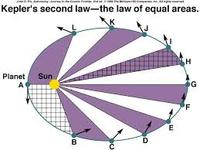
Where is the planet moving faster
Position A to B
Position B to C
Position H to I
Position I to J
Answer explanation
This question links to success criteria: I can use Kepler’s 2nd Law to predict when an orbiting body travels faster or slower in its own orbit.
If you got it correct place a check mark in the question results section. If you got it incorrect place an X in that section. If this was a redemption question, cross out the one X and replace it with a check mark.
6.
MULTIPLE CHOICE QUESTION
5 mins • 1 pt
Where is the planet moving slowest
Position A to B
Position B to C
Position H to I
Position I to J
Answer explanation
This question links to success criteria: I can use Kepler’s 2nd Law to predict when an orbiting body travels faster or slower in its own orbit.
If you got it correct place a check mark in the question results section. If you got it incorrect place an X in that section. If this was a redemption question, cross out the one X and replace it with a check mark.
7.
MULTIPLE CHOICE QUESTION
5 mins • 1 pt
What did Kepler discover about planets and their orbital speed?
Planets closest to the Sun will orbit with the fastest orbital speed.
Planets with the greatest mass will orbit the Sun with the fastest orbital speed.
Planets furthest from the Sun will orbit with the fastest orbital speed.
Planets with the least mass will orbit the Sun with the fastest orbital speed.
Answer explanation
This question links to success criteria: I can use Kepler’s 3rd Law to relate an object’s orbital radius to its orbital period.
If you got it correct place a check mark in the question results section. If you got it incorrect place an X in that section. If this was a redemption question, cross out the one X and replace it with a check mark.
Access all questions and much more by creating a free account
Create resources
Host any resource
Get auto-graded reports

Continue with Google

Continue with Email

Continue with Classlink

Continue with Clever
or continue with

Microsoft
%20(1).png)
Apple

Others
Already have an account?
Similar Resources on Wayground

10 questions
Magnetism - Review

Quiz
•
9th Grade
10 questions
Kuiz Senang
Quiz
•
7th - 9th Grade
7 questions
dimensional formula
Quiz
•
9th Grade - Professio...
10 questions
Electricity Quiz 1
Quiz
•
9th Grade
10 questions
1st Physics Quiz
Quiz
•
9th Grade
8 questions
Fizyka Atomowa
Quiz
•
1st Grade - Professio...
13 questions
MECHANICAL: Physics Equations on energy, work and power
Quiz
•
7th - 10th Grade
10 questions
EM Waves
Quiz
•
7th - 10th Grade
Popular Resources on Wayground
15 questions
Fractions on a Number Line
Quiz
•
3rd Grade
20 questions
Equivalent Fractions
Quiz
•
3rd Grade
25 questions
Multiplication Facts
Quiz
•
5th Grade
29 questions
Alg. 1 Section 5.1 Coordinate Plane
Quiz
•
9th Grade
22 questions
fractions
Quiz
•
3rd Grade
11 questions
FOREST Effective communication

Lesson
•
KG
20 questions
Main Idea and Details
Quiz
•
5th Grade
20 questions
Context Clues
Quiz
•
6th Grade
Discover more resources for Physics
10 questions
Exit Check 4.1 - Destructive Processes
Quiz
•
9th Grade
10 questions
Exit Check 4.2 - Constructive Forces
Quiz
•
9th Grade
10 questions
Exit Check 4.3 - Conservation of Momentum
Quiz
•
9th Grade
10 questions
Exit Check 4.4 - Momentum Calculations
Quiz
•
9th Grade
21 questions
EM Spectrum
Quiz
•
6th - 9th Grade
20 questions
Simple Machines and Mechanical Advantage Quiz
Quiz
•
9th Grade
14 questions
Graphs of Motion, Velocity & Acceleration
Quiz
•
8th - 9th Grade
21 questions
PE & KE Practice
Quiz
•
8th - 11th Grade