
Earth, Sun, Moon Review
Authored by Paula Willis
Science
5th Grade
NGSS covered
Used 2+ times


AI Actions
Add similar questions
Adjust reading levels
Convert to real-world scenario
Translate activity
More...
Content View
Student View
43 questions
Show all answers
1.
MULTIPLE CHOICE QUESTION
30 sec • 5 pts
Day and night on Earth occurs due to _____.
the rotation of the Earth
the tilt of the Earth's axis as it revolves around the Sun
the revolution of the moon around Earth
the rotation of our moon
Tags
NGSS.MS-ESS1-1
2.
MULTIPLE CHOICE QUESTION
30 sec • 5 pts
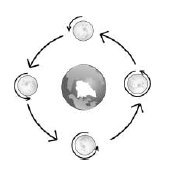
Which diagram best explains why the sun appears to move across the sky each day?


Tags
NGSS.MS-ESS1-1
3.
MULTIPLE CHOICE QUESTION
30 sec • 5 pts

When the sun is just above the East horizon, which of the following is true?
Sunset will occur in less than 2 hours.
Sunrise occurred within the last 6 hours.
Sunrise will occur in less than 2 hours.
Sunset occurred within the last 6 hours.
Tags
NGSS.MS-ESS1-1
4.
MULTIPLE CHOICE QUESTION
30 sec • 5 pts
A student pointed a flashlight modeling the Sun toward a globe modeling Earth. The student spun the globe. What was the student most likely demonstrating?
The moon's rotation on its axis causing day and night.
Earth's orbit around the Sun causing day and night
The sun's orbit around Earth causing day and night
The Earth rotation on its axis causing day and night.
Tags
NGSS.MS-ESS1-1
5.
MULTIPLE CHOICE QUESTION
30 sec • 5 pts
What do the Earth, Moon, and Sun have in common?
They all produce light.
They all have a rocky composition.
They all rotate.
They all are primarily composed of gases.
Tags
NGSS.MS-ESS1-1
6.
MULTIPLE CHOICE QUESTION
30 sec • 5 pts
Which of the following statements is true?
Earth's revolution causes the day and night cycle.
Earth takes 24 hours to revolves around the sun.
Earth rotates once every 24 hours.
The positions of other planets affect the day and night cycle.
7.
MULTIPLE CHOICE QUESTION
30 sec • 5 pts
A _____________ is the motion that one object in space takes around another object.
revolution
orbit
phase
rotation
Tags
NGSS.MS-ESS1-2
NGSS.MS-PS2-4
Access all questions and much more by creating a free account
Create resources
Host any resource
Get auto-graded reports

Continue with Google

Continue with Email

Continue with Classlink

Continue with Clever
or continue with

Microsoft
%20(1).png)
Apple

Others
Already have an account?


