
U4L4 - Properties of Types of Substances
Authored by Lauren Beglin
Chemistry
10th Grade
Used 3+ times


AI Actions
Add similar questions
Adjust reading levels
Convert to real-world scenario
Translate activity
More...
Content View
Student View
19 questions
Show all answers
1.
MULTIPLE CHOICE QUESTION
1 min • 1 pt
A sample of a hard, solid compound at room temperature did not conduct electricity as a pure solid but became highly conductive when dissolved in water. Which of the following types of interactions is most likely found between the particles in the substance?
Ionic bonds
Metallic bonds
Covalent bonds
Hydrogen bonds
2.
MULTIPLE CHOICE QUESTION
1 min • 1 pt

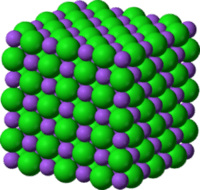
Which of the following most likely describes the solid represented in the diagram above?
It is soft and is a poor thermal and electrical conductor.
It has a low melting point and is a poor thermal and electrical conductor as a solid.
It is brittle and water-soluble that is a poor thermal and electrical conductor as a solid.
It is malleable and is an excellent thermal and electrical conductor as a solid.
3.
MULTIPLE CHOICE QUESTION
1 min • 1 pt

Three substances were studied in the laboratory, and the data in the table above were collected. Based on the data, which of the following shows the type of bonding in each substance?
Substance X: Network covalent; Substance Y: Ionic; Substance Z: Metallic
Substance X: Ionic; Substance Y: Molecular; Substance Z: Network covalent
Substance X: Molecular; Substance Y: Network covalent; Substance Z: Metallic
Substance X: Network covalent; Substance Y: Metallic; Substance Z: Ionic
4.
MULTIPLE CHOICE QUESTION
1 min • 1 pt
Molecular solids are made from ______.
5.
MULTIPLE CHOICE QUESTION
1 min • 1 pt
This type of solid will have the lowest boiling point.
6.
MULTIPLE CHOICE QUESTION
1 min • 1 pt
What is the basis of a metallic bond?
7.
MULTIPLE CHOICE QUESTION
1 min • 1 pt
Electrons that are free to move in metals

Access all questions and much more by creating a free account
Create resources
Host any resource
Get auto-graded reports

Continue with Google

Continue with Email

Continue with Classlink

Continue with Clever
or continue with

Microsoft
%20(1).png)
Apple

Others
Already have an account?

