
Arm Bones
Biology
11th - 12th Grade
Used 5K+ times


AI Actions
Add similar questions
Adjust reading levels
Convert to real-world scenario
Translate activity
More...
About
This quiz focuses on human skeletal system anatomy, specifically the bones and anatomical structures of the upper extremity. Designed for grades 11-12, the assessment requires students to identify major bones including the humerus, radius, ulna, scapula, and clavicle, along with specific anatomical landmarks such as the acromion, coracoid process, glenoid fossa, capitulum, trochlea, and olecranon fossa. Students must demonstrate mastery of bone classification and location, understanding the relationship between the axial and appendicular skeleton, and recognizing how anatomical structures relate to joint function and muscle attachment sites. The progression from major bones to specific anatomical features and hand bones (carpals, metacarpals, phalanges) reflects the detailed anatomical knowledge expected in advanced high school biology courses. Success requires memorization of anatomical terminology combined with spatial reasoning to visualize three-dimensional bone structures and their relative positions within the upper limb. This quiz was created by a classroom teacher who designed it for students studying upper extremity anatomy in grades 11-12. The assessment serves as an excellent tool for formative evaluation of anatomical knowledge, allowing teachers to quickly identify which students have mastered bone identification and which need additional support with specific structures. This type of quiz works effectively as a warm-up activity before laboratory sessions, as homework to reinforce textbook learning, or as review material before unit examinations on the skeletal system. Teachers can use the results to target instruction toward problematic anatomical regions and ensure students build the foundational knowledge necessary for understanding muscle origins and insertions, joint mechanics, and clinical applications. The quiz aligns with NGSS HS-LS1-2 standards for developing and using models to illustrate hierarchical organization of interacting systems, as students must understand how individual bones function within the larger musculoskeletal system.
Content View
Student View
18 questions
Show all answers
1.
MULTIPLE CHOICE QUESTION
30 sec • 1 pt

Radius
Ulna
Scapula
Humerus
2.
MULTIPLE CHOICE QUESTION
45 sec • 1 pt

Radius
Ulna
Humerus
Scapula
3.
MULTIPLE CHOICE QUESTION
45 sec • 1 pt

Radius
Ulna
Clavicle
Humerus
4.
MULTIPLE CHOICE QUESTION
20 sec • 1 pt

Radius
Ulna
Clavicle
Humerus
5.
MULTIPLE CHOICE QUESTION
45 sec • 1 pt
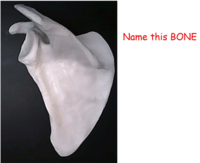
Clavicle
Scapula
Sternum
Radius
6.
MULTIPLE CHOICE QUESTION
30 sec • 1 pt

Acromion
Coracoid
Spine
Glenoid fossa
7.
MULTIPLE CHOICE QUESTION
30 sec • 1 pt

Acromion
Coracoid
Glenoid fossa
Spine


Access all questions and much more by creating a free account
Create resources
Host any resource
Get auto-graded reports

Continue with Google

Continue with Email

Continue with Classlink

Continue with Clever
or continue with

Microsoft
%20(1).png)
Apple

Others
Already have an account?


