
Unit 7 Evolution and Mutations
9th Grade
•18 Qs

Similar activities
Breathing (LC)
8th - 12th Grade
•19 Qs
Bio CDF Quizz
9th - 12th Grade
•17 Qs
Evolution
8th - 10th Grade
•15 Qs
The Nervous System
2nd Grade - University
•20 Qs
Cellular Respiration
9th - 12th Grade
•15 Qs
Learning the Cell Cycle
9th Grade
•13 Qs
Cell : Basic unit of Life
9th Grade
•22 Qs
Nutrition Practice
9th - 12th Grade
•20 Qs

Unit 7 Evolution and Mutations

Quiz
•
Biology
•
9th Grade
•
Easy

Hilary Schieffer
Used 5+ times
FREE Resource

Enhance your content in a minute
18 questions
Show all answers
1.
MULTIPLE CHOICE QUESTION
30 sec • 5 pts
Genetic drift is change in the allele frequency of a population due to...
random chance
natural selection
non-random mating (sexual selection)
artificial selection
2.
MULTIPLE CHOICE QUESTION
30 sec • 5 pts
All of the genetic information found in a population
population
genetic drift
evolution
gene pool
3.
MULTIPLE CHOICE QUESTION
30 sec • 5 pts
A mutation is defined as:
A change in the cell's structure
Anything that changes in an embryo
Any change in the physical features of a human
A change in the DNA sequence
4.
MULTIPLE CHOICE QUESTION
30 sec • 5 pts
What is natural selection?
When reproduction occurs and mutations happen.
When a offspring has the traits from its parents.
When an organism is able to camoflauge in its environment.
the process whereby organisms that are better adapted to their environment tend to survive and reproduce more offspring.
5.
MULTIPLE CHOICE QUESTION
30 sec • 1 pt
Humans, birds, whales, and lizards all have similar arm bones. What is the reason for this?
6.
MULTIPLE CHOICE QUESTION
30 sec • 1 pt

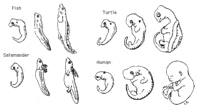
The structures shown are_________
7.
MULTIPLE CHOICE QUESTION
30 sec • 1 pt

Whales have pelvic bones. What type of structure does this best represent?
Homologous structure
Analogous structure
Vestigial structure
None of the above

Access all questions and much more by creating a free account
Create resources
Host any resource
Get auto-graded reports

Continue with Google

Continue with Email

Continue with Classlink

Continue with Clever
or continue with

Microsoft
%20(1).png)
Apple

Others
Already have an account?
Similar Resources on Wayground
20 questions
Name The Disney Animation Films
Quiz
•
KG - University
17 questions
B / HB Evolution: Misconceptions
Quiz
•
9th - 12th Grade
15 questions
Gas exchange
Quiz
•
9th - 12th Grade
15 questions
Cellular Respiration
Quiz
•
9th - 12th Grade
14 questions
Leaf Structure Day 2
Quiz
•
9th Grade - University
13 questions
Learning the Cell Cycle
Quiz
•
9th Grade
22 questions
Cell : Basic unit of Life
Quiz
•
9th Grade
16 questions
IGCSE Biology Photosynthesis
Quiz
•
9th - 10th Grade
Popular Resources on Wayground
15 questions
Fractions on a Number Line
Quiz
•
3rd Grade
20 questions
Equivalent Fractions
Quiz
•
3rd Grade
25 questions
Multiplication Facts
Quiz
•
5th Grade
22 questions
fractions
Quiz
•
3rd Grade
20 questions
Main Idea and Details
Quiz
•
5th Grade
20 questions
Context Clues
Quiz
•
6th Grade
15 questions
Equivalent Fractions
Quiz
•
4th Grade
20 questions
Figurative Language Review
Quiz
•
6th Grade
Discover more resources for Biology
20 questions
Cell Organelles
Quiz
•
9th Grade
20 questions
DNA & Protein Synthesis
Quiz
•
9th Grade
7 questions
Amoeba Sisters Dihybrid Cross Punnett Square

Interactive video
•
9th - 12th Grade
25 questions
photosynthesis and cellular respiration
Quiz
•
9th Grade
20 questions
Human Body Systems
Quiz
•
9th Grade
19 questions
Natural Selection
Quiz
•
9th Grade
20 questions
Pedigree Practice
Quiz
•
9th Grade
10 questions
Comparing Mitosis and Meiosis: Key Differences and Stages
Interactive video
•
6th - 10th Grade