
Evolution
9th Grade
•25 Qs

Similar activities
Microscopes
9th - 11th Grade
•23 Qs
Photosynthesis
9th Grade - University
•20 Qs
[Practice Test] Skeletal & Muscular Systems
9th Grade
•20 Qs
Animal science
4th - 12th Grade
•20 Qs
movement and muscles
6th Grade - University
•20 Qs
Y10: Homeostasis
9th - 12th Grade
•20 Qs

Evolution

Quiz
•
Biology
•
9th Grade
•
Easy

Rylee Ramsey
Used 2+ times
FREE Resource

Enhance your content in a minute
25 questions
Show all answers
1.
MULTIPLE CHOICE QUESTION
2 mins • 1 pt
Where the better adapted organisms survive to pass traits along to offspring.
2.
MULTIPLE CHOICE QUESTION
2 mins • 1 pt
Why are advantageous traits more likely to be passed onto offspring?
3.
MULTIPLE CHOICE QUESTION
2 mins • 1 pt

The trees these moths used to live on were white, but have been covered in soot from coal factories. Which moth will be more successful in this environment?
4.
MULTIPLE CHOICE QUESTION
2 mins • 1 pt
Change over time
5.
MULTIPLE CHOICE QUESTION
2 mins • 1 pt
Which best describes mutations?
6.
MULTIPLE CHOICE QUESTION
2 mins • 1 pt
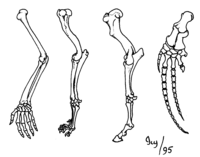
Structures with the same parts have different functions; suggests that organisms share a common ancestry
7.
MULTIPLE CHOICE QUESTION
2 mins • 1 pt
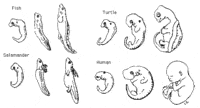
Study of embryos of various organisms to show a common ancestor because of similarities in development


Access all questions and much more by creating a free account
Create resources
Host any resource
Get auto-graded reports

Continue with Google

Continue with Email

Continue with Classlink

Continue with Clever
or continue with

Microsoft
%20(1).png)
Apple

Others
Already have an account?
Similar Resources on Wayground
20 questions
The Brain
Quiz
•
9th - 10th Grade
20 questions
Osmosis
Quiz
•
9th - 12th Grade
20 questions
NESİLLER TÜKENMESİN DOĞA BİZE KÜSMESİN
Quiz
•
9th - 12th Grade
20 questions
Molecular Transport
Quiz
•
9th Grade
20 questions
Periodiek Systeem - toepassingen
Quiz
•
9th Grade
20 questions
9ADV Homework 2
Quiz
•
9th Grade
20 questions
Animal Cell
Quiz
•
9th Grade
20 questions
Aquatic Ecosystem & Ocean Zones
Quiz
•
8th - 10th Grade
Popular Resources on Wayground
15 questions
Fractions on a Number Line
Quiz
•
3rd Grade
20 questions
Equivalent Fractions
Quiz
•
3rd Grade
25 questions
Multiplication Facts
Quiz
•
5th Grade
22 questions
fractions
Quiz
•
3rd Grade
20 questions
Main Idea and Details
Quiz
•
5th Grade
20 questions
Context Clues
Quiz
•
6th Grade
15 questions
Equivalent Fractions
Quiz
•
4th Grade
20 questions
Figurative Language Review
Quiz
•
6th Grade
Discover more resources for Biology
20 questions
Cell Organelles
Quiz
•
9th Grade
20 questions
DNA & Protein Synthesis
Quiz
•
9th Grade
7 questions
Amoeba Sisters Dihybrid Cross Punnett Square

Interactive video
•
9th - 12th Grade
25 questions
photosynthesis and cellular respiration
Quiz
•
9th Grade
20 questions
Human Body Systems
Quiz
•
9th Grade
19 questions
Natural Selection
Quiz
•
9th Grade
20 questions
Pedigree Practice
Quiz
•
9th Grade
10 questions
Comparing Mitosis and Meiosis: Key Differences and Stages
Interactive video
•
6th - 10th Grade