
Evidence of Evolution

Quiz
•
Biology
•
9th - 12th Grade
•
Medium
+5
Standards-aligned

Elliott Belden
Used 18+ times
FREE Resource
Student preview

17 questions
Show all answers
1.
MULTIPLE CHOICE QUESTION
2 mins • 1 pt

Some organisms have features that have different functions, but similar structures. One example is the forelimb of humans, dogs, birds, and whales. What term best describes the relationship between these forelimbs?
They are homologous.
They are vestigial.
They are analogous.
They are embryological.
Tags
NGSS.HS-LS4-1
2.
MULTIPLE CHOICE QUESTION
2 mins • 1 pt
How do fossils support evolution?
Individual species disappear and reappear in the fossil record over time.
Organisms in the fossil record are identical to living organisms.
The fossil record provides evidence that all organisms developed at the same time.
The fossil record provides evidence that organisms have changed over time.
Tags
NGSS.HS-LS4-1
3.
MULTIPLE CHOICE QUESTION
2 mins • 1 pt
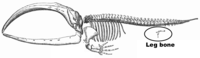
What best describes the hind leg bones seen in the whale?
The bones are analogous structures to the fins of living fish.
The bones are vestigial structures that had a function in an ancestor.
The bones are homologous structures to the wings of butterflies.
The bones are fossil structures from an extinct ancestor.
Tags
NGSS.HS-LS4-1
4.
MULTIPLE CHOICE QUESTION
2 mins • 1 pt
Which of the following would best determine whether two plant species share a recent common ancestor?
Flowering times
DNA sequences
Stem lengths
Habitat distribution
Tags
NGSS.HS-LS4-1
NGSS.HS-LS4-2
5.
MULTIPLE SELECT QUESTION
2 mins • 1 pt
Which of the following provide evidence for evolution? (Select all that apply)
physical features
molecular features, such as DNA
geographical information
fossils
Tags
NGSS.HS-LS4-1
6.
MULTIPLE CHOICE QUESTION
2 mins • 1 pt

Which scientist visited the Galapagos Islands, observed traits in finches, and came up with the theory of natural selection?
Alfred Russell Wallace
Jean-Baptiste Lamarck
Carolus Linnaeus
Charles Darwin
Tags
NGSS.HS-LS4-4
7.
MULTIPLE CHOICE QUESTION
2 mins • 1 pt
Mutations are important because they bring about --
death in the organisms in which they develop.
benefits for the individual, not the population.
genetic variation needed for a population to evolve.
equilibrium within a population.
Tags
NGSS.HS-LS3-2
NGSS.HS-LS4-2

Access all questions and much more by creating a free account
Create resources
Host any resource
Get auto-graded reports

Continue with Google

Continue with Email

Continue with Classlink

Continue with Clever
or continue with

Microsoft
%20(1).png)
Apple

Others
Already have an account?
Popular Resources on Wayground

8 questions
2 Step Word Problems
Quiz
•
KG - University
20 questions
Comparing Fractions
Quiz
•
4th Grade
15 questions
Fractions on a Number Line
Quiz
•
3rd Grade
20 questions
Equivalent Fractions
Quiz
•
3rd Grade
25 questions
Multiplication Facts
Quiz
•
5th Grade
10 questions
Latin Bases claus(clois,clos, clud, clus) and ped
Quiz
•
6th - 8th Grade
22 questions
fractions
Quiz
•
3rd Grade
7 questions
The Story of Books
Quiz
•
6th - 8th Grade
Discover more resources for Biology
20 questions
Cell Organelles
Quiz
•
10th Grade
20 questions
Macromolecules
Quiz
•
10th Grade
20 questions
Cell Organelles
Quiz
•
9th Grade
20 questions
DNA & Protein Synthesis
Quiz
•
9th Grade
14 questions
Ecological Succession: Primary and Secondary
Quiz
•
9th Grade
20 questions
FAKE IT TILL YOU MAKE IT Organelles
Quiz
•
10th Grade
51 questions
Weather, Climate Change, Cycles
Quiz
•
9th Grade
7 questions
Amoeba Sisters Dihybrid Cross Punnett Square

Interactive video
•
9th - 12th Grade