
8.LS4.3 Study Guide/Review
8th Grade
•22 Qs

Similar activities
Elements, Compounds, and Valence Electrons
8th Grade
•17 Qs
F2 CHAPTER 8.3 LEVER
8th Grade
•20 Qs
Vertebrates
5th - 9th Grade
•20 Qs
The space quiz
5th Grade - Professional Development
•17 Qs
Unit 1: Waves - Lesson 4 - Part 2
6th - 8th Grade
•20 Qs
REVIEW GIUA KI 1 K8
8th Grade
•20 Qs
sound
8th Grade
•20 Qs

8.LS4.3 Study Guide/Review

Quiz
•
Science
•
8th Grade
•
Medium
+3
Standards-aligned

MELODY WAGSTAFF
Used 13+ times
FREE Resource

Enhance your content in a minute
22 questions
Show all answers
1.
MULTIPLE CHOICE QUESTION
2 mins • 1 pt
Which statement best describes the process of evolution?
Tags
NGSS.MS-LS4-1
NGSS.MS-LS4-2
NGSS.MS-LS4-4
2.
MULTIPLE CHOICE QUESTION
2 mins • 1 pt
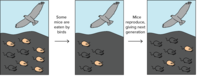
Why is the mouse population changing over time?
Tags
NGSS.MS-LS2-4
NGSS.MS-LS4-4
3.
MULTIPLE CHOICE QUESTION
2 mins • 1 pt
Species with ______variation are ______likely to survive.
Tags
NGSS.MS-LS4-4
4.
MULTIPLE CHOICE QUESTION
2 mins • 1 pt
Which of the following is NOT an example of natural selection?
Tags
NGSS.MS-LS4-4
5.
MULTIPLE CHOICE QUESTION
2 mins • 1 pt
Which describes the relationship between evolution and natural selection?
Natural selection is the outcome, evolution is a hypothesis
Evolution is the outcome, natural selection is the process
Natural selection is always happening, evolution happens rarely
Evolution and Natural selection are the same idea just different words
Tags
NGSS.MS-LS4-4
6.
MULTIPLE CHOICE QUESTION
2 mins • 1 pt
Briefly explain each of the 4 key principles that
natural selection is based on.
Variation- is among species and is natural differences or a random in traits
Adaptation- when someone is suited for their environment
Overproduction- more of the offsprings produce more that can survive
Selection- when an adaptation is passed from generation to generation to enable organisms to survive
Natural selection lead to the development of giraffes with long necks because when there was short neck giraffes they couldn't reach the top of the tree to get food so they would die out and long neck giraffes took over
The two advantages are you get most of the traits you want and you get a new puppy. Two disadvantages that u get it is some of the traits are negative and the gene pool is less diverse
Tags
NGSS.MS-LS1-4
NGSS.MS-LS2-4
7.
MULTIPLE CHOICE QUESTION
2 mins • 1 pt
Mutations are important because they bring about
death of the organism in which they develop
genetic variation needed for a population to evolve
benefits for the individual, not for the population
Hardey-Weinberg equilibrium within a population
Tags
NGSS.MS-LS4-4
Access all questions and much more by creating a free account
Create resources
Host any resource
Get auto-graded reports

Continue with Google

Continue with Email

Continue with Classlink

Continue with Clever
or continue with

Microsoft
%20(1).png)
Apple

Others
Already have an account?
Similar Resources on Wayground
18 questions
Sources of Energy
Quiz
•
7th - 10th Grade
17 questions
Reflection and Mirrors
Quiz
•
8th Grade
20 questions
Chapter 6 Quiz: A Trip Through Geologic Time
Quiz
•
8th Grade
20 questions
Winds,Storms and Cyclones
Quiz
•
6th - 12th Grade
17 questions
Microscope
Quiz
•
7th - 12th Grade
20 questions
Unit 2: Forces and Motion (quiz#1)
Quiz
•
8th Grade
17 questions
Work, Power, and Energy
Quiz
•
8th Grade
21 questions
Essential Chemistry
Quiz
•
7th - 8th Grade
Popular Resources on Wayground
15 questions
Fractions on a Number Line
Quiz
•
3rd Grade
20 questions
Equivalent Fractions
Quiz
•
3rd Grade
25 questions
Multiplication Facts
Quiz
•
5th Grade
54 questions
Analyzing Line Graphs & Tables
Quiz
•
4th Grade
22 questions
fractions
Quiz
•
3rd Grade
20 questions
Main Idea and Details
Quiz
•
5th Grade
20 questions
Context Clues
Quiz
•
6th Grade
15 questions
Equivalent Fractions
Quiz
•
4th Grade
Discover more resources for Science
20 questions
Cell Organelles and Functions
Quiz
•
6th - 8th Grade
33 questions
Grade 6 Quarter 3 PMA 5 Review
Quiz
•
6th - 8th Grade
10 questions
Exploring the Rock Cycle: Types and Formation

Interactive video
•
6th - 8th Grade
10 questions
Exploring the Layers of the Earth
Interactive video
•
6th - 10th Grade
14 questions
Biodiversity and Sustainability Quiz
Quiz
•
8th Grade
20 questions
Heredity Punnett square review
Quiz
•
8th Grade
23 questions
Newton's 3 Laws of Motion
Quiz
•
8th Grade
10 questions
Exploring the Rock Cycle
Interactive video
•
6th - 8th Grade