
Quiz 10.3- Evidence of Evolution (35Qs)
Authored by Kimberly Amstutz
Biology
9th Grade
Used 2+ times


AI Actions
Add similar questions
Adjust reading levels
Convert to real-world scenario
Translate activity
More...
Content View
Student View
35 questions
Show all answers
1.
MULTIPLE CHOICE QUESTION
45 sec • 1 pt
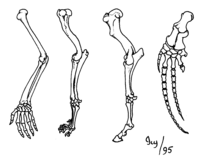
Structures with the same parts have different functions; suggests that organisms share a common ancestry
2.
MULTIPLE CHOICE QUESTION
1 min • 1 pt
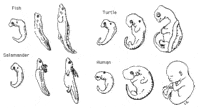
Study of embryos of various organisms to show a common ancestor because of similarities in development
3.
MULTIPLE CHOICE QUESTION
1 min • 5 pts

Some organisms that share a common ancestor have features that have different functions, but similar structures. These are known as
4.
MULTIPLE CHOICE QUESTION
3 mins • 1 pt
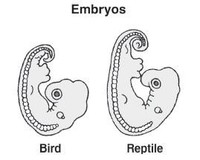
The diagram illustrates an embryonic stage of two organisms.
Which of the following can be determined by observing the embryos shown in the diagram
5.
MULTIPLE CHOICE QUESTION
30 sec • 1 pt
Humans, birds, whales, and lizards all have similar arm bones. What is the reason for this?
6.
MULTIPLE CHOICE QUESTION
30 sec • 5 pts

Vestigial structures
structures that perform a similar function but are not similar in origin
remnants of once-important structures that have slowly lost all or most of their function
features found in different organisms that share structural similarities but may have very different functions
preserved remains of an organism
7.
MULTIPLE CHOICE QUESTION
30 sec • 1 pt
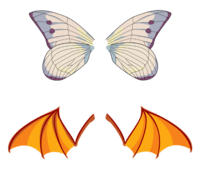
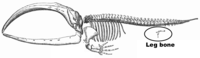
What is this an example of?
Homologous structure
Analogous structure
Vestigial organs
Functional adaption
Access all questions and much more by creating a free account
Create resources
Host any resource
Get auto-graded reports

Continue with Google

Continue with Email

Continue with Classlink

Continue with Clever
or continue with

Microsoft
%20(1).png)
Apple

Others
Already have an account?


