
Hominoid Evolution
Authored by Charles Martinez
Biology
9th - 12th Grade
NGSS covered
Used 1+ times


AI Actions
Add similar questions
Adjust reading levels
Convert to real-world scenario
Translate activity
More...
Content View
Student View
5 questions
Show all answers
1.
MULTIPLE CHOICE QUESTION
1 min • 1 pt
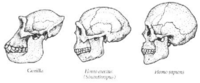
Scientists have found evidence that about 2.4 million years ago a gene regulating jaw muscles mutated and may have led to the more graceful human jaw we see today. The diagram below shows the skulls of 3 hominid species. Which statement below most closely explains the link between jaw size and hominid evolution?
The jaws of hominids evolved to be smaller and less protruding over time as did the skull.
The jaws of hominids evolved to be larger and more protruding over time.
There appears to be no change in the jaws of hominids over time.
The jaws of hominids changed over time due to a change in brain size
Tags
NGSS.MS-LS4-2
NGSS.MS-LS4-1
2.
MULTIPLE CHOICE QUESTION
1 min • 1 pt
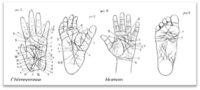
Based on the illustration to the right, what do the similarities between human and chimpanzee hands and feet suggest about the different organisms?
Chimpanzees and humans both have hands and feet adapted for walking upright, showing they have identical DNA.
Chimpanzees and humans both have similar hands for grasping, proving they make and use complex tools.
Humans and chimpanzees both developed five digits on their hands and feet, suggesting they have a common ancestor.
Humans and chimpanzees both have thumbs, proving they eat similar foods like meat, nuts, and vegetation.
Tags
NGSS.MS-LS4-2
3.
MULTIPLE CHOICE QUESTION
1 min • 1 pt
How is the scientific theory of evolution supported by the comparison of the skulls and skeletons of modern humans and extinct hominids?
By making the hip, spine, and skull comparisons, the age of different hominid specimens can be determined.
Comparison of skull and skeletons provides evidence that humans and different hominid species interacted.
Similarity in skull shapes, hands, and hips between extinct hominids and humans supports a common ancestry.
Skull and skeleton comparisons can explain why hominids were inferior and became extinct while humans evolved.
Tags
NGSS.MS-LS4-2
4.
MULTIPLE CHOICE QUESTION
1 min • 1 pt
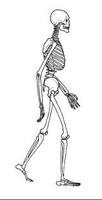
The ability to walk upright on two legs is called:
bipedalism
quadropedalism
bicyclepedalism
tripedalism
5.
MULTIPLE CHOICE QUESTION
1 min • 1 pt
Which of the following correctly summarizes the physical changes that early humans went through over the past million years or so?
Access all questions and much more by creating a free account
Create resources
Host any resource
Get auto-graded reports

Continue with Google

Continue with Email

Continue with Classlink

Continue with Clever
or continue with

Microsoft
%20(1).png)
Apple

Others
Already have an account?
Similar Resources on Wayground

10 questions
Chemical Energy and ATP

Quiz
•
9th - 12th Grade
10 questions
Quiz - Respiration in plants and animals
Quiz
•
5th - 12th Grade
10 questions
Nervous System 10B
Quiz
•
10th Grade
10 questions
Plant Nutrition
Quiz
•
9th - 11th Grade
10 questions
Respiration and Circulation
Quiz
•
9th Grade
10 questions
Climate Change Video
Quiz
•
9th Grade
10 questions
IB Biology Topic 2.5 Review
Quiz
•
10th - 12th Grade
8 questions
Plant Cells & Microorganisms
Quiz
•
5th - 9th Grade
Popular Resources on Wayground
15 questions
Fractions on a Number Line
Quiz
•
3rd Grade
20 questions
Equivalent Fractions
Quiz
•
3rd Grade
25 questions
Multiplication Facts
Quiz
•
5th Grade
22 questions
fractions
Quiz
•
3rd Grade
20 questions
Main Idea and Details
Quiz
•
5th Grade
20 questions
Context Clues
Quiz
•
6th Grade
15 questions
Equivalent Fractions
Quiz
•
4th Grade
20 questions
Figurative Language Review
Quiz
•
6th Grade
Discover more resources for Biology
20 questions
Cell Organelles
Quiz
•
10th Grade
20 questions
Cell Organelles
Quiz
•
9th Grade
20 questions
DNA & Protein Synthesis
Quiz
•
9th Grade
7 questions
Amoeba Sisters Dihybrid Cross Punnett Square

Interactive video
•
9th - 12th Grade
25 questions
photosynthesis and cellular respiration
Quiz
•
9th Grade
20 questions
Human Body Systems
Quiz
•
9th Grade
19 questions
Natural Selection
Quiz
•
9th Grade
20 questions
Pedigree Practice
Quiz
•
9th Grade