
EOC Review Semester 1
Authored by Justin Madden
Biology
9th Grade
Used 2+ times


AI Actions
Add similar questions
Adjust reading levels
Convert to real-world scenario
Translate activity
More...
Content View
Student View
40 questions
Show all answers
1.
MULTIPLE CHOICE QUESTION
30 sec • 12 pts
This is one job proteins do not have in the body.
structure for tissues and organs
transport things through cell membranes
speed up chemical reactions
insulation
2.
MULTIPLE CHOICE QUESTION
30 sec • 1 pt
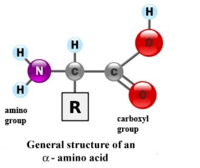
The diagram shows the general structure of an amino acid. Which type of molecule is formed from amino acids?
3.
MULTIPLE CHOICE QUESTION
30 sec • 1 pt
Many plants have waxy coatings on some surfaces. This coating reduces water loss because it is not water-permeable. This waxy coating is which of the following types of organic molecule?
4.
MULTIPLE CHOICE QUESTION
30 sec • 1 pt
The human body maintains a temperature of around 98.6 degrees at all times. Enzymes are involved in almost every chemical reaction in the body. Which of the following describes the connection between these two statements?
5.
MULTIPLE CHOICE QUESTION
30 sec • 1 pt
In living organisms, lipids function mainly as:
6.
MULTIPLE CHOICE QUESTION
30 sec • 1 pt
To convert the radiant energy of the sun into the chemical energy of glucose through the process of photosynthesis is a function of _________.
Large Central Vacuole
7.
MULTIPLE CHOICE QUESTION
30 sec • 12 pts
Provides support and protection for the cell while also controlling the movement of materials in and out of the cell.
Access all questions and much more by creating a free account
Create resources
Host any resource
Get auto-graded reports

Continue with Google

Continue with Email

Continue with Classlink

Continue with Clever
or continue with

Microsoft
%20(1).png)
Apple

Others
Already have an account?


