
End of Unit Evolution Quiz
6th - 8th Grade
•25 Qs

Similar activities
The Sun 15.3
KG - University
•20 Qs
Arthropods
6th Grade
•20 Qs
UCEA yr8 Charles Darwin
5th - 12th Grade
•20 Qs
SEL
KG - University
•20 Qs
Living Things in Their Environment and Human Influences on the Environment
8th Grade
•20 Qs
Grade 8 Term 1+2
8th Grade
•22 Qs
YALL WILL NOT WIN
KG - 12th Grade
•20 Qs
Genes AVA year 8
7th Grade
•20 Qs

End of Unit Evolution Quiz

Quiz
•
Biology
•
6th - 8th Grade
•
Medium

Cheryl Denton-Bell
Used 1+ times
FREE Resource

Enhance your content in a minute
25 questions
Show all answers
1.
MULTIPLE CHOICE QUESTION
30 sec • 5 pts
When every organism of a species has died.
2.
MATCH QUESTION
30 sec • 1 pt
Match the following terms with their definitions
Any variation that makes an organism better able to survive
Evolution
An inherited trait that makes and individual different
Mutation
a change in a species DNA over time because of natural selection
Adaptation
A permanent change in the DNA
Variation
3.
MULTIPLE CHOICE QUESTION
30 sec • 1 pt
Differences in traits are called:
natural selection
genetic variations
artificial selection
adaptations
4.
MULTIPLE CHOICE QUESTION
30 sec • 1 pt
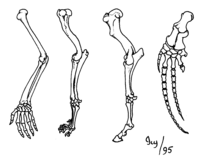
Structures with the same parts have different functions; suggests that organisms share a common ancestry
5.
MULTIPLE CHOICE QUESTION
30 sec • 1 pt

Two organisms that are closely related would have
6.
MULTIPLE CHOICE QUESTION
1 min • 1 pt
Who was the first naturalist to study evolution?
7.
MULTIPLE CHOICE QUESTION
1 min • 1 pt
This is a process by which organisms inherited advantageous traits that tend to reproduce more successfully than the other organisms do.

Access all questions and much more by creating a free account
Create resources
Host any resource
Get auto-graded reports

Continue with Google

Continue with Email

Continue with Classlink

Continue with Clever
or continue with

Microsoft
%20(1).png)
Apple

Others
Already have an account?
Similar Resources on Wayground
20 questions
Symbiotic Relationships and Ecosystems
Quiz
•
8th Grade
20 questions
Cell Quiz
Quiz
•
6th - 9th Grade
20 questions
Structure of Flowering Plant
Quiz
•
7th Grade
20 questions
Biology Animal Symmetry
Quiz
•
7th - 8th Grade
21 questions
Photosynthesis vs. Cellular Respiration
Quiz
•
7th - 8th Grade
20 questions
Heart Circulation
Quiz
•
7th Grade
20 questions
Enzymes
Quiz
•
8th - 11th Grade
21 questions
B5 - Genes and variation
Quiz
•
5th - 10th Grade
Popular Resources on Wayground
15 questions
Fractions on a Number Line
Quiz
•
3rd Grade
20 questions
Equivalent Fractions
Quiz
•
3rd Grade
25 questions
Multiplication Facts
Quiz
•
5th Grade
22 questions
fractions
Quiz
•
3rd Grade
20 questions
Main Idea and Details
Quiz
•
5th Grade
20 questions
Context Clues
Quiz
•
6th Grade
15 questions
Equivalent Fractions
Quiz
•
4th Grade
20 questions
Figurative Language Review
Quiz
•
6th Grade
Discover more resources for Biology
10 questions
Comparing Mitosis and Meiosis: Key Differences and Stages

Interactive video
•
6th - 10th Grade
20 questions
cell theory and organelles
Quiz
•
6th - 8th Grade
14 questions
Reading Comprehension SC.7.L.15.1

Passage
•
8th Grade
10 questions
Cell Structure and Function Concepts
Interactive video
•
6th - 10th Grade
20 questions
The Cell Cycle
Quiz
•
7th Grade
10 questions
Natural Selection and Adaptation in Evolution
Interactive video
•
6th - 10th Grade
15 questions
Pedigrees
Quiz
•
7th - 12th Grade
10 questions
Cellular Respiration
Quiz
•
7th - 8th Grade