
9.6 ming and ottoman
Authored by Noel Vargas
History
University
Used 3+ times


AI Actions
Add similar questions
Adjust reading levels
Convert to real-world scenario
Translate activity
More...
Content View
Student View
25 questions
Show all answers
1.
MULTIPLE CHOICE QUESTION
3 mins • 1 pt
From Food Gathering To Food Producing
. . . Paleolithic men could not control their food supply. So long as they relied on foraging, hunting, fishing, and trapping, they were dependent on the natural food supply in a given area to keep from starving. But while Paleolithic men continued their food-gathering pattern of existence in Europe, Africa, and Australia, groups of people in the Near East began to cultivate edible plants and to breed animals. Often described as the “first economic revolution” in the history of man, this momentous change from a food-gathering to a food-producing economy initiated the Neolithic Age. Paleolithic man was a hunter; Neolithic man became a farmer and herdsman. . . .
Based on the passage above, identify one advantage of living the way “Neolithic man” lived.
More leisure time
More reliable food sources
More travel
Greater knowledge of wild plants
2.
MULTIPLE CHOICE QUESTION
30 sec • 1 pt
From Food Gathering To Food Producing
. . . Paleolithic men could not control their food supply. So long as they relied on foraging, hunting, fishing, and trapping, they were dependent on the natural food supply in a given area to keep from starving. But while Paleolithic men continued their food-gathering pattern of existence in Europe, Africa, and Australia, groups of people in the Near East began to cultivate edible plants and to breed animals. Often described as the “first economic revolution” in the history of man, this momentous change from a food-gathering to a food-producing economy initiated the Neolithic Age. Paleolithic man was a hunter; Neolithic man became a farmer and herdsman. . . .
Identify one effect of the change discussed in the excerpt above.
Most humans became nomads.
People had more equal rights in their societies.
Life expectancy shortened.
The first civilizations developed.
3.
MULTIPLE CHOICE QUESTION
30 sec • 1 pt

Which concept is most closely associated with this map of Asia?
Nonalignment
urbanization
Colonization
cultural diffusion
4.
MULTIPLE CHOICE QUESTION
30 sec • 1 pt
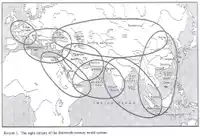
Based on this map of 13th-century world systems, which of these circuits was limited to one continent?
I
II
V
VI
5.
MULTIPLE CHOICE QUESTION
30 sec • 1 pt

The information on this map implies that trade made these regions
militaristic
interconnected
isolationist
ethnocentric
6.
MULTIPLE CHOICE QUESTION
30 sec • 1 pt
Li Si was a strong supporter of legalism and served as the Grand Counselor to Emperor Shi Huangdi (259-210 BCE) in China. In this passage, Li Si is responding to a scholar who has challenged the Emperor’s movement away from traditional values.
… “I humbly propose that all historical records but those of Chin [Qin] be burned. If anyone who is not a court scholar dares to keep the ancient songs, historical records or writings of the hundred schools, these should be confiscated and burned by the provincial governor and army commander. Those who in conversation dare to quote the old songs and records should be publicly executed; those who use old precedents [examples] to oppose the new order should have their families wiped out; and officers who know of such cases but fail to report them should be punished in the same way.
“If thirty days after the issuing of this order the owners of these books have still not had them destroyed, they should have their faces tattooed and be condemned to hard labour at the Great Wall. The only books which need not be destroyed are those dealing with medicine, divination and agriculture. Those who want to study the law can learn it from the officers.” The emperor sanctioned [approved] this proposal.…
Source: Szuma Chien, Records of the Historian,
Based on the excerpt above, identify Li Si’s point of view.
Medicine, divination, and agriculture are the most important topics to study.
Building the Great Wall is a reward for studying important topics.
Traditional values are a threat to Shi Huangdi’s power
Shi Huangdi will not bring China prosperity
7.
MULTIPLE CHOICE QUESTION
30 sec • 1 pt
Li Si was a strong supporter of legalism and served as the Grand Counselor to Emperor Shi Huangdi (259-210 BCE) in China. In this passage, Li Si is responding to a scholar who has challenged the Emperor’s movement away from traditional values.
… “I humbly propose that all historical records but those of Chin [Qin] be burned. If anyone who is not a court scholar dares to keep the ancient songs, historical records or writings of the hundred schools, these should be confiscated and burned by the provincial governor and army commander. Those who in conversation dare to quote the old songs and records should be publicly executed; those who use old precedents [examples] to oppose the new order should have their families wiped out; and officers who know of such cases but fail to report them should be punished in the same way.
“If thirty days after the issuing of this order the owners of these books have still not had them destroyed, they should have their faces tattooed and be condemned to hard labour at the Great Wall. The only books which need not be destroyed are those dealing with medicine, divination and agriculture. Those who want to study the law can learn it from the officers.” The emperor sanctioned [approved] this proposal.…
Source: Szuma Chien, Records of the Historian
A historian could best use this source to
Find out about Shi Huangdi’s values as a leader
Determine working conditions at the Great Wall
Learn how scholars protested Shi Huangdi’s policies
Explore common tattoos in Classical China
Access all questions and much more by creating a free account
Create resources
Host any resource
Get auto-graded reports

Continue with Google

Continue with Email

Continue with Microsoft
or continue with

%20(1).png)
Apple

Others
By signing up, you agree to our Terms of Service & Privacy Policy
Already have an account?

