
Evolution Unit Exam
Authored by Traci Johnson
Biology
6th - 8th Grade
Used 1+ times


AI Actions
Add similar questions
Adjust reading levels
Convert to real-world scenario
Translate activity
More...
Content View
Student View
18 questions
Show all answers
1.
DRAG AND DROP QUESTION
3 mins • 8 pts
Computers and software continue to change and improve over time. We can say that information technology is rapidly evolving. The biological (a) is a scientific theory that states that new species of life develop from a common ancestor over time. This is the result of a process called (b) .
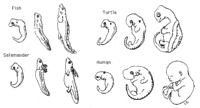
The Theory shows the (c) of organisms from single cell to multicell complex organisms. The theory is based on findings from fossil records, skeletal structures of vertebrates, molecular similarities and differences between organisms, comparative embryology, and (d) .
2.
DRAG AND DROP QUESTION
3 mins • 10 pts
Like a photograph, (a) give scientists clues into the past. They can be rocks that have the imprint of living things that were on Earth (b) of years ago, or they can be the remains of the organism itself, such as (c) , which may have turned into rock. Most fossils are formed when a (d) dies and is (e) beneath mud or sand.
3.
MULTIPLE SELECT QUESTION
3 mins • 8 pts
Which of the following are evidence that supports evolution? (select all that apply)
fossils
similarities in early development
similarities in body structure
similarities in DNA
hieroglyphs in the ancient Egyptian tombs
4.
MULTIPLE CHOICE QUESTION
3 mins • 2 pts

An anatomical feature that no longer seams to have a purpose in the current form of an organism, like pelvic bones in whales, is an example of what?
Vestigial Structure
Homologous Structure
Homophones
Support for another set of flippers
5.
MULTIPLE CHOICE QUESTION
3 mins • 2 pts

Structures with the same anatomical make up but different functions (homologous structures) is evidence that those structures came from
a common ancestor because structures are coded from DNA
different ancestors because structures come from our RNA
the same ancestors because they are used in the same way
an alien ancestor because the is the only explanation
6.
MULTIPLE CHOICE QUESTION
3 mins • 2 pts

Comparing DNA sequences shows___.
How closely related organisms are
Traits that can become available
Evolution is not real
That organisms have evolved from several different organisms.
7.
MULTIPLE CHOICE QUESTION
3 mins • 2 pts

If an organism has a vestigial structure, that structure likely once had a function in a(n)

Access all questions and much more by creating a free account
Create resources
Host any resource
Get auto-graded reports

Continue with Google

Continue with Email

Continue with Classlink

Continue with Clever
or continue with

Microsoft
%20(1).png)
Apple

Others
Already have an account?
Similar Resources on Wayground

20 questions
keys and variation

Quiz
•
8th Grade
13 questions
Vocab 4/ DNA Quiz Review
Quiz
•
7th Grade
13 questions
INTERACT GENERAL KNOWLEGE TRIVIA
Quiz
•
7th - 12th Grade
20 questions
Cell Organelles
Quiz
•
8th - 10th Grade
16 questions
Energy Flow Through Living Systems
Quiz
•
6th - 8th Grade
15 questions
Ecological organization and interactions quiz
Quiz
•
6th - 8th Grade
16 questions
Chapter 3: Biochemistry
Quiz
•
8th - 10th Grade
20 questions
BIOLOGY 101
Quiz
•
8th Grade
Popular Resources on Wayground
15 questions
Fractions on a Number Line
Quiz
•
3rd Grade
20 questions
Equivalent Fractions
Quiz
•
3rd Grade
25 questions
Multiplication Facts
Quiz
•
5th Grade
22 questions
fractions
Quiz
•
3rd Grade
20 questions
Main Idea and Details
Quiz
•
5th Grade
20 questions
Context Clues
Quiz
•
6th Grade
15 questions
Equivalent Fractions
Quiz
•
4th Grade
20 questions
Figurative Language Review
Quiz
•
6th Grade
Discover more resources for Biology
10 questions
Comparing Mitosis and Meiosis: Key Differences and Stages

Interactive video
•
6th - 10th Grade
20 questions
cell theory and organelles
Quiz
•
6th - 8th Grade
14 questions
Reading Comprehension SC.7.L.15.1

Passage
•
8th Grade
10 questions
Cell Structure and Function Concepts
Interactive video
•
6th - 10th Grade
20 questions
The Cell Cycle
Quiz
•
7th Grade
10 questions
Natural Selection and Adaptation in Evolution
Interactive video
•
6th - 10th Grade
15 questions
Pedigrees
Quiz
•
7th - 12th Grade
10 questions
Cellular Respiration
Quiz
•
7th - 8th Grade