
Energy Transfer and Electric Currents
4th Grade
•26 Qs

Similar activities
Science Vocab
4th - 5th Grade
•21 Qs
Gravity of Earth
4th Grade
•25 Qs
mandolorian
3rd - 5th Grade
•22 Qs
The sense organs
4th Grade
•22 Qs
Basic Astronomy
2nd - 5th Grade
•23 Qs
weather (cuaca) - Teacher Fiza
1st - 6th Grade
•21 Qs
Light and Shadow 4º IPC Altillo
4th Grade
•21 Qs
Energy Transfer and Electric Currents

Quiz
•
Science
•
4th Grade
•
Practice Problem
•
Medium
+7
Standards-aligned

Stacey Martin
Used 154+ times
FREE Resource

Enhance your content in a minute
26 questions
Show all answers
1.
MULTIPLE CHOICE QUESTION
1 min • 1 pt

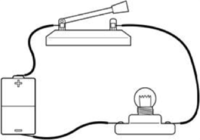
Which of the following explains what happens when the light bulb lights up? When the switch is closed---
energy moves through the wires and is changed into light energy in the bulb
the bulb reflects sunlight until it shines brightly and makes heat energy.
the physical properties of the battery are changed by the chemicals inside it
the wires that connect the parts stop heat energy from flowing
Tags
NGSS.MS-PS3-5
2.
MULTIPLE CHOICE QUESTION
1 min • 1 pt

Students are using a hand-held generator to produce light energy. The light only lights up when the handle is turned.
What can the students do to change the amount of energy that enters the bulb?
Place a filter over the light bulb
Turn the handle at different speeds
Change the handle to a smaller one
Use a different bulb
Tags
NGSS.MS-PS3-5
3.
MULTIPLE CHOICE QUESTION
1 min • 1 pt

The illustration below shows a lamp that is plugged into an electrical outlet.
When the lamp is turned on and the bulb is lit, it shows that electrical energy–
moves in straight lines
is produced by moving water
can be changed into light energy
is the fastest moving form of energy
Tags
NGSS.4-PS3-2
4.
MULTIPLE CHOICE QUESTION
1 min • 1 pt
Which of the following is evidence that electrical energy can be moved from place to place? Power plants that make electricity–
cost quite a bit of money to build and run.
are often very far from the places that receive the electricity.
sometimes use moving water to make electricity.
need people and materials in order to make electricity.
Tags
NGSS.MS-PS3-4
5.
MULTIPLE CHOICE QUESTION
1 min • 1 pt
Which of the following provides evidence that light energy can move from place to place?
A flashlight turns on when the switch is moved.
A light bulb gets hot when it is left on for a while.
The deepest parts of the ocean are very dark.
very distant stars can be seen in the night sky.
Tags
NGSS.MS-PS4-2
6.
MULTIPLE CHOICE QUESTION
1 min • 1 pt
The movement of electrically charged particles is
7.
MULTIPLE CHOICE QUESTION
1 min • 1 pt
A(n) is a closed, or complete, path in which an electric
current flows.
Access all questions and much more by creating a free account
Create resources
Host any resource
Get auto-graded reports

Continue with Google

Continue with Email

Continue with Classlink

Continue with Clever
or continue with

Microsoft
%20(1).png)
Apple

Others
Already have an account?
Similar Resources on Wayground
22 questions
บ้านแตออ มฟน แฟนพันธุ์เทียม 22 ข้อพอ คิดไม่ทัน
Quiz
•
1st - 5th Grade
24 questions
Unit 3 - Light and Energy 4th grade
Quiz
•
4th Grade
23 questions
Water Cycle Quiz
Quiz
•
4th Grade
23 questions
Solar System
Quiz
•
3rd - 4th Grade
23 questions
The Moon Earth's Natural Satellite
Quiz
•
4th - 5th Grade
23 questions
Sol Ecosystems
Quiz
•
3rd - 5th Grade
21 questions
We protect our bones and muscles
Quiz
•
4th Grade
21 questions
Light and Sound Review
Quiz
•
4th Grade
Popular Resources on Wayground
15 questions
Fractions on a Number Line
Quiz
•
3rd Grade
20 questions
Equivalent Fractions
Quiz
•
3rd Grade
25 questions
Multiplication Facts
Quiz
•
5th Grade
22 questions
fractions
Quiz
•
3rd Grade
20 questions
Main Idea and Details
Quiz
•
5th Grade
20 questions
Context Clues
Quiz
•
6th Grade
15 questions
Equivalent Fractions
Quiz
•
4th Grade
20 questions
Figurative Language Review
Quiz
•
6th Grade
Discover more resources for Science
15 questions
Physical and Chemical Changes
Quiz
•
4th Grade
15 questions
Changes in Ecosystems
Quiz
•
4th Grade
21 questions
Weathering, Erosion, and Deposition
Quiz
•
4th Grade
9 questions
Weather Map
Quiz
•
4th Grade
15 questions
Weathering and Erosion

Interactive video
•
4th Grade
10 questions
Identifying Physical and Chemical Changes
Interactive video
•
1st - 5th Grade
20 questions
Rapid Changes to Earth's Surface
Quiz
•
3rd - 5th Grade
9 questions
Transfer of Energy - 4.8A Picture Vocabulary

Lesson
•
4th Grade