
Macromolecules
9th - 12th Grade
•35 Qs

Similar activities
Biology Unit-3 Test
11th - 12th Grade
•40 Qs
active and passive transport
10th Grade
•33 Qs
Yr 11 Bio: Cell size, structure and function
11th - 12th Grade
•40 Qs
Aquatic biodiversity and Agriculture
10th - 12th Grade
•33 Qs
Biology Quiz Ch2
10th Grade
•32 Qs
Carbohydrates, Fibre and Water
12th Grade
•30 Qs
Mitosis or Meiosis, DNA or RNA
8th - 11th Grade
•30 Qs
Unit 1 - Variables, Water, Macromolecules
10th Grade
•35 Qs

Macromolecules

Quiz
•
Biology
•
9th - 12th Grade
•
Medium

Dan Duhon
Used 39+ times
FREE Resource

Enhance your content in a minute
35 questions
Show all answers
1.
MULTIPLE CHOICE QUESTION
30 sec • 1 pt
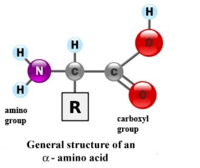
The diagram shows the general structure of an amino acid. Which type of molecule is formed from amino acids?
2.
MULTIPLE CHOICE QUESTION
30 sec • 1 pt
Fats, oils and cholesterol are all types of what?
hormones
3.
MULTIPLE CHOICE QUESTION
30 sec • 1 pt
RNA and DNA are which type of macromolecules?
4.
MULTIPLE CHOICE QUESTION
30 sec • 1 pt
Many plants have waxy coatings on some surfaces. This coating reduces water loss because it is not water-permeable. This waxy coating is which of the following types of organic molecule?
5.
MULTIPLE CHOICE QUESTION
30 sec • 1 pt
A sugar, a phosphate group, and a nitrogen base form the building blocks of which organic compound?
6.
MULTIPLE CHOICE QUESTION
30 sec • 1 pt
The human body maintains a temperature of around 98.6 degrees at all times. Enzymes are involved in almost every chemical reaction in the body. Which of the following describes the connection between these two statements?
7.
MULTIPLE CHOICE QUESTION
30 sec • 1 pt
Like complex carbohydrates, proteins are macromolecules that serve many functions and can be chemically broken down and restructured. Both proteins and complex carbohydrates are which of the following?

Access all questions and much more by creating a free account
Create resources
Host any resource
Get auto-graded reports

Continue with Google

Continue with Email

Continue with Classlink

Continue with Clever
or continue with

Microsoft
%20(1).png)
Apple

Others
Already have an account?
Similar Resources on Wayground
30 questions
Bio - Chapter 1: Science of Biology
Quiz
•
9th - 10th Grade
30 questions
Cell Structure and Function
Quiz
•
7th - 10th Grade
40 questions
Cell Structures
Quiz
•
KG - University
30 questions
Unit 1-3 Exam Review
Quiz
•
9th Grade
39 questions
Fall Final Review 1
Quiz
•
9th Grade
33 questions
Directional Anatomy Practice
Quiz
•
11th - 12th Grade
35 questions
Enzymes and Reactions
Quiz
•
10th Grade
40 questions
Lobo Bio RC3
Quiz
•
9th - 12th Grade
Popular Resources on Wayground
15 questions
Fractions on a Number Line
Quiz
•
3rd Grade
20 questions
Equivalent Fractions
Quiz
•
3rd Grade
25 questions
Multiplication Facts
Quiz
•
5th Grade
22 questions
fractions
Quiz
•
3rd Grade
20 questions
Main Idea and Details
Quiz
•
5th Grade
20 questions
Context Clues
Quiz
•
6th Grade
15 questions
Equivalent Fractions
Quiz
•
4th Grade
20 questions
Figurative Language Review
Quiz
•
6th Grade
Discover more resources for Biology
20 questions
Cell Organelles
Quiz
•
10th Grade
20 questions
Cell Organelles
Quiz
•
9th Grade
20 questions
DNA & Protein Synthesis
Quiz
•
9th Grade
7 questions
Amoeba Sisters Dihybrid Cross Punnett Square

Interactive video
•
9th - 12th Grade
25 questions
photosynthesis and cellular respiration
Quiz
•
9th Grade
20 questions
Human Body Systems
Quiz
•
9th Grade
19 questions
Natural Selection
Quiz
•
9th Grade
20 questions
Pedigree Practice
Quiz
•
9th Grade