
Benchmark Review: Atoms, Particles, Reactions and COM
8th Grade
•25 Qs

Similar activities
TABLA PERIÓDICA
1st - 10th Grade
•20 Qs
Chapter 8: Force and Motion
8th Grade
•20 Qs
PAS GANJIL IPA - KELAS VIII
8th Grade
•20 Qs
6th Grade CBA 4 Review
6th - 8th Grade
•20 Qs
QUIZ SISTEM EKSKRESI
8th Grade
•20 Qs
Weathering Study/Review Guide
5th - 8th Grade
•20 Qs
Quiz Motion Graphs
8th Grade
•20 Qs
4.4 PERSENYAWAAN DAN KEHAMILAN
8th - 12th Grade
•20 Qs

Benchmark Review: Atoms, Particles, Reactions and COM

Quiz
•
Science
•
8th Grade
•
Medium

Kemon Jones
Used 3+ times
FREE Resource
25 questions
Show all answers
1.
MULTIPLE CHOICE QUESTION
30 sec • 1 pt
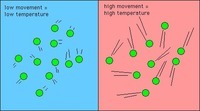
What happens to particles when their temperature increases?
The particles move slower
The particles move faster
The particles lose mass
The particles gain mass
2.
MULTIPLE CHOICE QUESTION
30 sec • 1 pt

3.
MULTIPLE CHOICE QUESTION
30 sec • 1 pt
4.
MULTIPLE CHOICE QUESTION
1 min • 1 pt

The model shows ice in a particle model. As thermal energy increased, the water particles _________________.
moved apart; increased speed
moved closer; increased speed
moved apart; decreased speed
moved closer; decreased speed
5.
MULTIPLE CHOICE QUESTION
30 sec • 1 pt
In which state of matter are the molecules spaced farthest apart?
Solid
Liquid
Gas
All are equal
6.
MULTIPLE CHOICE QUESTION
30 sec • 1 pt
According to the Law of Conservation of Mass,
matter is always created in a chemical reaction
matter is always destroyed in a chemical reaction
matter is created and then destroyed in a chemical reaction
matter is not created or destroyed in a chemical reaction
7.
MULTIPLE CHOICE QUESTION
30 sec • 1 pt
The law of conservation of mass can be demonstrated by a chemical reaction. Which of the following models of a chemical reaction best represents the law of conservation of mass?


Create a free account and access millions of resources
Create resources
Host any resource
Get auto-graded reports

Continue with Google

Continue with Email

Continue with Classlink

Continue with Clever
or continue with

Microsoft
%20(1).png)
Apple

Others
By signing up, you agree to our Terms of Service & Privacy Policy
Already have an account?
Similar Resources on Wayground
22 questions
moteur diesel
Quiz
•
1st - 9th Grade
20 questions
PSHB IPA KELAS 8 GENAP
Quiz
•
8th Grade
20 questions
Genetics Vocab
Quiz
•
8th Grade
21 questions
Opowieść wigilijna
Quiz
•
1st - 9th Grade
21 questions
Properties of Solids, Liquids and Gases Based on the Particl
Quiz
•
8th Grade
20 questions
Electron Configuration
Quiz
•
8th - 10th Grade
22 questions
Tema 3º. Diversidad de la materia.
Quiz
•
8th Grade
20 questions
CE Rev - Chem 3
Quiz
•
7th - 9th Grade
Popular Resources on Wayground
20 questions
Brand Labels
Quiz
•
5th - 12th Grade
11 questions
NEASC Extended Advisory

Lesson
•
9th - 12th Grade
10 questions
Ice Breaker Trivia: Food from Around the World
Quiz
•
3rd - 12th Grade
10 questions
Boomer ⚡ Zoomer - Holiday Movies
Quiz
•
KG - University
25 questions
Multiplication Facts
Quiz
•
5th Grade
22 questions
Adding Integers
Quiz
•
6th Grade
10 questions
Multiplication and Division Unknowns
Quiz
•
3rd Grade
20 questions
Multiplying and Dividing Integers
Quiz
•
7th Grade
Discover more resources for Science
20 questions
Physical and Chemical Changes
Quiz
•
8th Grade
22 questions
Newton's Laws of Motion
Lesson
•
8th Grade
12 questions
Phases of Matter
Quiz
•
8th Grade
20 questions
Distance Time Graphs
Quiz
•
6th - 8th Grade
21 questions
Balanced and Unbalanced Forces
Quiz
•
8th Grade
10 questions
Exploring Newton's Laws of Motion

Interactive video
•
6th - 10th Grade
12 questions
Speed, Velocity, and Acceleration
Lesson
•
6th - 8th Grade
19 questions
Forces and Motion
Lesson
•
6th - 8th Grade