
Warm-up 9/26 (Enzyme Review)
Authored by Laura Rodriguez
Biology
9th - 12th Grade
NGSS covered
Used 8+ times


AI Actions
Add similar questions
Adjust reading levels
Convert to real-world scenario
Translate activity
More...
Content View
Student View
10 questions
Show all answers
1.
MULTIPLE CHOICE QUESTION
30 sec • 5 pts
At high temperatures, the rate of enzyme action decreases because the increased heat......
neutralizes the acids and bases in the system
alters the shape of the active site of the enzyme
increases the concentration of the enzyme
changes the pH of the system
2.
MULTIPLE CHOICE QUESTION
30 sec • 5 pts

Which enzyme would you expect to find in bacteria growing in a hot environment?
Enzyme X
Enzyme Y
3.
MATCH QUESTION
2 mins • 20 pts

Using the diagram, match the following.
Substrate
C
Enzyme Substrate Complex
D
Enzyme
E
Product
B
Active Site
A
Tags
NGSS.HS-LS1-6
NGSS.HS-PS1-2
4.
MULTIPLE CHOICE QUESTION
30 sec • 1 pt
Enzymes are capable of increasing the rate of a chemical reaction within a living cell. Enzymes accomplish this through which of the following means?
reducing the number of products
reducing the activation energy
increasing the temperature of the cell
increasing the concentration of reactants
Answer explanation
Activation energy is the energy the reaction needs to get going. Usually it is quite high, and that is why some reactions take a very long time to get going if they get going at all.
Enzymes LOWER the ACTIVATION ENERGY of a reaction, hence speeding it up!
Tags
NGSS.HS-PS1-4
5.
MULTIPLE CHOICE QUESTION
30 sec • 1 pt

The graph shows how enzymes affect reactions in cells. Which statement best summarizes the information shown in the graph?
Enzymes increase the energy of the reactants.
Enzymes decrease the energy level of the products.
Enzyme decrease the activation energy of the reaction.
Enzymes reverse the direction of the reaction.
Answer explanation
The graph clearly shows the reaction goes quicker when the enzyme is present and the activation energy is lowered.
Tags
NGSS.HS-PS1-4
6.
MULTIPLE CHOICE QUESTION
30 sec • 1 pt
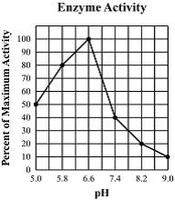
Which of the following conclusions can be drawn from this graph?
The optimum pH of the enzyme is 6.6.
The optimum pH of the enzyme is 5.8
The enzyme’s activity increases as pH increases 5.0 to 9.0
The enzyme’s activity is greater around pH of 8.0 .
Answer explanation
Remember, OPTIMUM is the usually the highest point on the graph and shows the 'best' value.
7.
MULTIPLE CHOICE QUESTION
45 sec • 1 pt

Which statement best describes the enzyme represented in the graphs below?
This enzyme works best at a temperature of 35°C and a pH of 8
This enzyme works best at a temperature of 50°C and a pH of 12
Temperature and pH have no influence on the activity of this enzyme
This enzyme works best at a temperature above 50°C and a pH above 12
Answer explanation
For this question you are looking for TWO OPTIMUM values, one for temperature and one for pH.
Tags
NGSS.HS-PS1-5


Access all questions and much more by creating a free account
Create resources
Host any resource
Get auto-graded reports

Continue with Google

Continue with Email

Continue with Classlink

Continue with Clever
or continue with

Microsoft
%20(1).png)
Apple

Others
Already have an account?

