
CFU: Chapter 10: How Cells Divide
Authored by Gilberto Villarreal
Science
12th Grade
Used 6+ times


AI Actions
Add similar questions
Adjust reading levels
Convert to real-world scenario
Translate activity
More...
Content View
Student View
35 questions
Show all answers
1.
DROPDOWN QUESTION
5 mins • 5 pts
Bacterial cell division
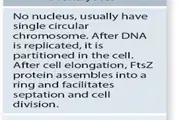
Bacteria divide by binary fission
•No sexual (a) cycle.
• (b) is clonal.
Single, circular bacterial chromosome is replicated
Replication begins at the origin of (c) and proceeds in (d) directions to site of termination
New chromosomes are partitioned to (e) ends of the cell
Septum forms to divide the cell into two cells.
2.
MULTIPLE CHOICE QUESTION
5 mins • 2 pts
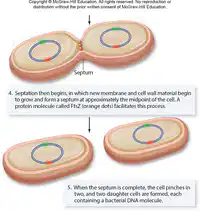
True or False:
According to the notes, during binary fission the last step it mentions that the cell pinches in two, and three daughter cells are formed, each containing a bacterial DNA molecule.
A. True
B. False
3.
MULTIPLE CHOICE QUESTION
5 mins • 2 pts
True or False:
Production of septum separates cell’s other components
Begins with formation of ring of FtsZ proteins.
Accumulation of other proteins follow.
Structure contracts radially to pinch cell in two.
FtsZ protein found in most eukaryotes.
A. True
B. False
4.
MULTIPLE CHOICE QUESTION
5 mins • 2 pts
True or False:
FtsZ protein has a structure similar to bacterial tubulin
Role of FtsZ in bacterial division is very similiar from the role of tubulin in mitosis in prokaryotes.
Different protein assemblies are utilized in cell division by different organisms.
A. True
B. False
5.
MULTIPLE CHOICE QUESTION
5 mins • 2 pts
True or False:
Eukaryotes typically have 10-50 chromosomes in their body (somatic) cells
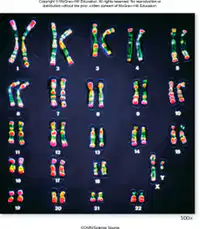
Humans have 46 chromosomes in 23 nearly identical pairs
•Additional/missing chromosomes usually fatal.
A. True
B. False
6.
MATCH QUESTION
5 mins • 5 pts
Match the following:
Protein assemblies across organisms
Some Protists
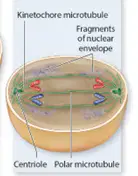
Yeasts
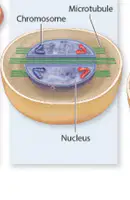
Animals
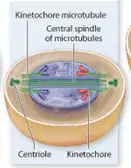
Other Protists
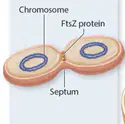
Prokaryotes
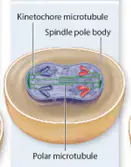
7.
MATCH QUESTION
5 mins • 5 pts
Match the following:
Protein assemblies across organisms
Animals

Some Protists
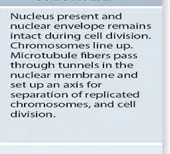
Prokaryotes
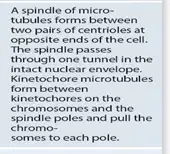
Other Protists
Yeasts
Access all questions and much more by creating a free account
Create resources
Host any resource
Get auto-graded reports

Continue with Google

Continue with Email

Continue with Classlink

Continue with Clever
or continue with

Microsoft
%20(1).png)
Apple

Others
Already have an account?


