
Solar System Models and Kepler's Laws
Authored by Lynn Blustein
Science
9th - 12th Grade


AI Actions
Add similar questions
Adjust reading levels
Convert to real-world scenario
Translate activity
More...
Content View
Student View
22 questions
Show all answers
1.
MULTIPLE CHOICE QUESTION
30 sec • 1 pt
Planets orbit the Sun in a shape called a(n)
circle
ellipse
focus
perihelion
2.
MULTIPLE CHOICE QUESTION
30 sec • 1 pt
An ellipse is drawn around two points called
aphelion
perihelion
foci
axis
3.
MULTIPLE CHOICE QUESTION
30 sec • 1 pt
When a planet orbits the Sun, one of the foci of the elliptical orbit is
the axis
the perihelion
the center
the Sun
4.
MULTIPLE CHOICE QUESTION
30 sec • 1 pt
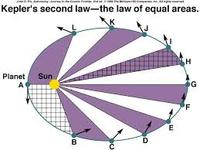
Where is the planet moving faster
Position A to B
Position B to C
Position H to I
Position I to J
5.
MULTIPLE CHOICE QUESTION
30 sec • 1 pt
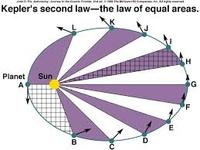
What is true about the area between points A, B and the Sun, and the area between points H, I and the Sun?
The area between A, B and the Sun is the largest.
The area between H, I and the Sun is the largest
Both areas are equal in size
There is not enough information to determine the areas
6.
MULTIPLE CHOICE QUESTION
30 sec • 1 pt
What has an eccentricity of zero
a straight line
a large ellipse
a circle
a small ellipse
7.
MULTIPLE CHOICE QUESTION
30 sec • 1 pt
Kepler's 2nd Law deals with
the shape of the planets' orbits
the speed/area the planet travels
the length of time it takes the planet to orbit the sun

Access all questions and much more by creating a free account
Create resources
Host any resource
Get auto-graded reports

Continue with Google

Continue with Email

Continue with Classlink

Continue with Clever
or continue with

Microsoft
%20(1).png)
Apple

Others
Already have an account?


