
Fall 2023 Semester Review - Part III
Authored by Coach Hernandez
Biology
9th - 12th Grade
Used 8+ times


AI Actions
Add similar questions
Adjust reading levels
Convert to real-world scenario
Translate activity
More...
Content View
Student View
25 questions
Show all answers
1.
MULTIPLE CHOICE QUESTION
15 mins • 4 pts
Where the better adapted organisms survive to pass traits along to offspring.
2.
MULTIPLE CHOICE QUESTION
1 min • 4 pts

The trees these moths used to live on were white, but have been covered in soot from coal factories. Which moth will be more successful in this environment?
3.
MULTIPLE CHOICE QUESTION
1 min • 4 pts
Which best describes mutations?
4.
MULTIPLE CHOICE QUESTION
1 min • 4 pts
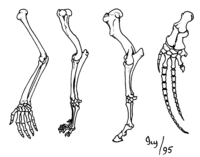
Structures with the same parts have different functions; suggests that organisms share a common ancestry
5.
MULTIPLE CHOICE QUESTION
1 min • 4 pts

Base your answer(s) to question(s) on the diagram below and on your knowledge of biology. The diagram shows the heads of four different species of Galapagos Islands finches.
The four different types of beaks shown are most likely the result of
6.
MULTIPLE CHOICE QUESTION
1 min • 4 pts
What do we call traits that increase an individual's chance to survive and reproduce?
7.
MULTIPLE CHOICE QUESTION
30 sec • 4 pts

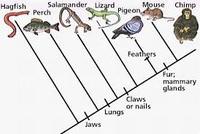
According to this phylogenetic tree, which creature is the least related out of all pictured?
Fish
Frog
Salamander
Human

Access all questions and much more by creating a free account
Create resources
Host any resource
Get auto-graded reports

Continue with Google

Continue with Email

Continue with Classlink

Continue with Clever
or continue with

Microsoft
%20(1).png)
Apple

Others
Already have an account?


