
class 11 heat and thermodynamics
Authored by DebaD Kashyap
Physics
11th Grade
Used 24+ times


AI Actions
Add similar questions
Adjust reading levels
Convert to real-world scenario
Translate activity
More...
Content View
Student View
25 questions
Show all answers
1.
MULTIPLE CHOICE QUESTION
30 sec • 1 pt
For the formula:
Q= m c ∆T
The units for specific heat are:
g /J C
°C/g J
kJ/g
J/g°C
2.
MULTIPLE CHOICE QUESTION
30 sec • 1 pt
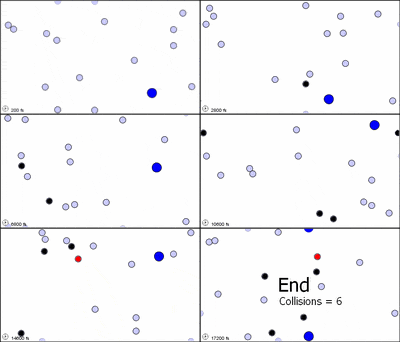
What would be the effect on the particles if more heat is supplied to the system?
They would slow down
They would stop moving
They would speed up
There would be no effect
3.
MULTIPLE CHOICE QUESTION
30 sec • 1 pt
If the specific heat of water is 4,186 J/kg∙°C, how much heat is required to increase the temperature of 1.2 kg of water from 23 °C to 39 °C?
-80,371.2
44,938.6
80,371.2
112,575.9
4.
MULTIPLE CHOICE QUESTION
30 sec • 1 pt
Steam at temperature of 100°C is piped to 3 kg of water at the temperature of 5°C until the water reaches the boiling point. The mass of the steam required is
[Specific latent heat of vaporization of water = 2.26 × 10⁶ J kg−1, specific heat capacity of water = 4.2 × 10³ J kg−1°C−1]
0.26 kg
0.53 kg
0.94 kg
1.89 kg
5.
MULTIPLE CHOICE QUESTION
30 sec • 1 pt
What is the definition of CONDUCTION?
When heat is transferred from objects like rays of light or electromagnetically.
a hot liquid or air that expands, becomes less dense, and rises or becomes more dense, and sinks.
When heat transfers from objects that are touching.
When heat transfers through the heater or AC in your house.
6.
MULTIPLE CHOICE QUESTION
30 sec • 1 pt
What is the definition of CONVECTION
When heat transfers through the heater or AC in your house.
When heat transfers from objects that are touching.
a hot liquid or air that expands, becomes less dense, and rises or becomes more dense, and sinks.
hot liquid or air that expands, becomes less dense, and rises or becomes more dense, and sinks.
7.
MULTIPLE CHOICE QUESTION
30 sec • 1 pt
What is the definition of RADIATION
hot liquid or air that expands, becomes less dense, and rises or becomes more dense, and sinks.
When heat is transferred from objects like rays of light or electromagnetically.
When heat transfers from objects that are touching.
When heat transfers through the heater or AC in your house.


Access all questions and much more by creating a free account
Create resources
Host any resource
Get auto-graded reports

Continue with Google

Continue with Email

Continue with Classlink

Continue with Clever
or continue with

Microsoft
%20(1).png)
Apple

Others
Already have an account?



