
Genetics & Evolution Quiz
9th - 12th Grade
•50 Qs

Similar activities
Ujian Sistem Gerak
11th Grade - University
•50 Qs
Rosedale SS genetics unit 4
11th - 12th Grade
•50 Qs
Circulation, heart and a little bit of scientific method
9th Grade
•53 Qs
Biology Experiments
10th Grade
•50 Qs
UAS MIKROBIOLOGI
10th Grade - University
•45 Qs
Review 2
11th Grade - Professional Development
•54 Qs
UAS PAI
12th Grade
•45 Qs
Male vs Female Reproductive Sys Qs
9th - 11th Grade
•50 Qs

Genetics & Evolution Quiz

Quiz
•
Biology
•
9th - 12th Grade
•
Medium

Nichole SouthGarnerHS
Used 5+ times
FREE Resource

Enhance your content in a minute
50 questions
Show all answers
1.
MULTIPLE CHOICE QUESTION
1 min • 1 pt

The four butterflies in the illustration represent the offspring in the F1 generation. Which statement is best supported by the phenotypes of these offspring?
The F1 generation is composed only of males.
Two of the offspring in the F1 generation will not be able to reproduce.
The F1 generation is the result of a dihybrid cross.
Two of the offspring in the F1 generation will experience a spontaneous mutation
2.
MULTIPLE CHOICE QUESTION
1 min • 1 pt

The initial steps in gene expression are modeled. Double-stranded DNA first unwinds into two strands. Which process and product are represented in the diagrams?
Process: transcription; product: mRNA
Process: translation; product: protein
Process: replication; product: tRNA
Process: recombination; product: polymerase
3.
MULTIPLE CHOICE QUESTION
1 min • 1 pt

Name the process in the picture.
4.
MULTIPLE CHOICE QUESTION
1 min • 1 pt

The diagram represents one way an enzyme can be inhibited. Which statement explains the effect of an inhibitor on an enzyme?
A substrate will be able to bond with the enzyme.
The enzyme will likely be attacked by immune cells
The enzyme will be unable to produce more enzymes.
A substrate will be unable to attach to the enzyme.
5.
MULTIPLE CHOICE QUESTION
1 min • 1 pt

An analysis of DNA and RNA sequences can be used to classify organisms. A dendrogram, such as the one shown, is based on molecular data. It can be used to represent evolutionary relationships within a group of organisms that are hypothesized to have descended from a common ancestor. Which statement is best supported by the information in this dendrogram?
Lesser pandas are more genetically similar to giant pandas than they are to raccoons.
Brown bears are more genetically similar to giant pandas than they are to sun bears.
Lesser pandas are more genetically similar to raccoons than they are to giant pandas.
The bear species are all more genetically similar to dogs than they are to giant pandas.
6.
MULTIPLE CHOICE QUESTION
1 min • 1 pt
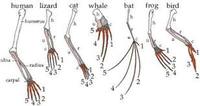
What is this an example of?
7.
MULTIPLE CHOICE QUESTION
1 min • 1 pt
How do scientists cut DNA into smaller strands?


Access all questions and much more by creating a free account
Create resources
Host any resource
Get auto-graded reports

Continue with Google

Continue with Email

Continue with Classlink

Continue with Clever
or continue with

Microsoft
%20(1).png)
Apple

Others
Already have an account?
Similar Resources on Wayground
50 questions
Struktur dan Fungsi Sel
Quiz
•
9th - 12th Grade
50 questions
Male vs Female Reproductive Sys Qs
Quiz
•
9th - 11th Grade
50 questions
Práctica Prueba 1 Biología undécimo
Quiz
•
11th Grade
50 questions
Protein Translation
Quiz
•
9th - 12th Grade
50 questions
Final Review
Quiz
•
9th - 10th Grade
50 questions
PSAT PRAKARYA XII 2024-2025
Quiz
•
12th Grade - University
45 questions
UAS PAI
Quiz
•
12th Grade
Popular Resources on Wayground
15 questions
Fractions on a Number Line
Quiz
•
3rd Grade
20 questions
Equivalent Fractions
Quiz
•
3rd Grade
25 questions
Multiplication Facts
Quiz
•
5th Grade
22 questions
fractions
Quiz
•
3rd Grade
20 questions
Main Idea and Details
Quiz
•
5th Grade
20 questions
Context Clues
Quiz
•
6th Grade
15 questions
Equivalent Fractions
Quiz
•
4th Grade
20 questions
Figurative Language Review
Quiz
•
6th Grade
Discover more resources for Biology
20 questions
Cell Organelles
Quiz
•
10th Grade
20 questions
Cell Organelles
Quiz
•
9th Grade
20 questions
DNA & Protein Synthesis
Quiz
•
9th Grade
7 questions
Amoeba Sisters Dihybrid Cross Punnett Square

Interactive video
•
9th - 12th Grade
25 questions
photosynthesis and cellular respiration
Quiz
•
9th Grade
20 questions
Human Body Systems
Quiz
•
9th Grade
19 questions
Natural Selection
Quiz
•
9th Grade
20 questions
Pedigree Practice
Quiz
•
9th Grade