
UNIT 1: Mechanics and Materials_JAN 2023_2
Authored by Aishwaria Murthy
Physics
10th Grade
Used 2+ times


AI Actions
Add similar questions
Adjust reading levels
Convert to real-world scenario
Translate activity
More...
Content View
Student View
53 questions
Show all answers
1.
MULTIPLE CHOICE QUESTION
30 sec • 1 pt
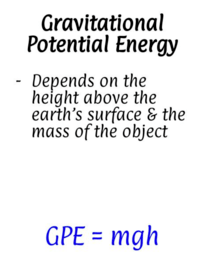
The formula for calculating the gravitational potential energy in an object is shown above. Which object will have the largest value for its GPE




2.
MULTIPLE SELECT QUESTION
2 mins • 1 pt
What are Equations for Gravitational Potential Energy?
Gravitational Potential Energy = Mass x Gravitational Field Strength x Height
Gravitational Potential Energy = Weight x Height
Gravitational Potential Energy = Mass x Gravitational Field Strength / Height
Gravitational Potential Energy = Weight / Height
3.
MULTIPLE SELECT QUESTION
2 mins • 1 pt
An object is speeding up when: (Choose All That Apply) (May have to choose more than 1 to be right)
it is gaining kinetic energy.
it is losing kinetic energy.
it is gaining gravitational potential energy.
it is losing gravitational potential energy.
4.
MULTIPLE CHOICE QUESTION
1 min • 1 pt
The sum of the kinetic and potential energy in a system is known as the system's _____________________ energy.
mechanical
chemical
thermal
combined
5.
MULTIPLE CHOICE QUESTION
30 sec • 1 pt
Sentence: "And just so you know, this could be different kinds of potential energy, be it gravitational or elastic. However, for this video, we'll just be looking at the gravitational potential energy."
a. What types of potential energy are mentioned?
i. Gravitational only
ii. Elastic only
iii. Both gravitational and elastic
iv. Nuclear and magnetic
6.
MULTIPLE CHOICE QUESTION
30 sec • 1 pt
"The key concept we need to understand in this lesson is that, just like the law of conservation of energy says, the mechanical energy in a closed system is always conserved. This means that even though the kinetic energy might change and the potential energy might change, the total sum of these two don't change. That is, energy simply transforms from one type to the other; if one goes up, the other goes down."
a. What is the key concept explained in this lesson?
i. Conservation of kinetic energy
ii. Conservation of potential energy
iii. Conservation of mechanical energy
iv. Conservation of elastic energy
7.
MULTIPLE CHOICE QUESTION
30 sec • 1 pt
If the kinetic energy changes will it have any effect on mechanical Energy?
Yes
Access all questions and much more by creating a free account
Create resources
Host any resource
Get auto-graded reports

Continue with Google

Continue with Email

Continue with Microsoft
or continue with

%20(1).png)
Apple

Others
Already have an account?


