
ADV Parallel and Series Circuits
Authored by Helen Rowland Ward
Physics
8th Grade
NGSS covered
Used 5+ times


AI Actions
Add similar questions
Adjust reading levels
Convert to real-world scenario
Translate activity
More...
Content View
Student View
10 questions
Show all answers
1.
MULTIPLE CHOICE QUESTION
1 min • 1 pt
What is a parallel circuit?
A circuit in which the components are not connected to a voltage source
A circuit in which the components are connected in series to the same voltage source
A circuit in which the components are connected in parallel to the same voltage source, allowing current to flow through multiple paths.
A circuit in which the components are connected to different voltage sources
2.
MULTIPLE CHOICE QUESTION
1 min • 1 pt
What is a series circuit?
A circuit in which the components are connected in a single path, so the same current flows through all the components.
A circuit in which the components are not connected to each other, allowing the current to flow in any direction.
A circuit in which the components are connected in a loop, causing the current to split and flow through different paths.
A circuit in which the components are connected in multiple paths, so the current can flow through different components at different rates.
3.
MULTIPLE CHOICE QUESTION
1 min • 1 pt
Define a series circuit.
A circuit in which the components are connected in a single path for the current to flow.
A circuit in which the components are connected in a random pattern for the current to flow.
A circuit in which the components are not connected to allow the current to flow.
A circuit in which the components are connected in multiple paths for the current to flow.
4.
MULTIPLE CHOICE QUESTION
1 min • 1 pt
What are the advantages of parallel circuits?
Limited paths for current to flow and dependent operation of components
Higher resistance and lower voltage
Single path for current to flow and shared operation of components
Multiple paths for current to flow and independent operation of components
5.
MULTIPLE CHOICE QUESTION
1 min • 1 pt
List two disadvantages of series circuits.
If one component fails, all components stop working and total resistance increases
Series circuits are more efficient than parallel circuits
Components in series circuits can be easily added or removed without affecting the circuit
If one component fails, other components work harder and total resistance decreases
6.
MULTIPLE CHOICE QUESTION
1 min • 1 pt
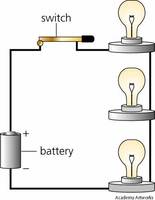
What kind of circuit is this?
7.
MULTIPLE CHOICE QUESTION
1 min • 1 pt
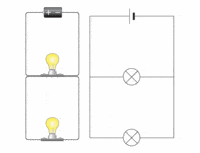
What kind of circuit is this?


Access all questions and much more by creating a free account
Create resources
Host any resource
Get auto-graded reports

Continue with Google

Continue with Email

Continue with Classlink

Continue with Clever
or continue with

Microsoft
%20(1).png)
Apple

Others
Already have an account?
Similar Resources on Wayground

12 questions
Magnetism and Electromagnetism

Quiz
•
7th - 10th Grade
10 questions
Mid-year Check-In Grade 8 Science
Quiz
•
8th Grade
10 questions
Power Plants
Quiz
•
8th Grade
10 questions
Magnetism and Electromagnetism Quiz
Quiz
•
5th - 10th Grade
12 questions
Kinetic Theory
Quiz
•
7th - 10th Grade
10 questions
Series VS Parallel
Quiz
•
8th Grade
15 questions
Electric Circuits
Quiz
•
8th Grade
10 questions
Rube Goldberg & Simple Machines
Quiz
•
3rd - 8th Grade
Popular Resources on Wayground
8 questions
Spartan Way - Classroom Responsible
Quiz
•
9th - 12th Grade
15 questions
Fractions on a Number Line
Quiz
•
3rd Grade
14 questions
Boundaries & Healthy Relationships

Lesson
•
6th - 8th Grade
20 questions
Equivalent Fractions
Quiz
•
3rd Grade
3 questions
Integrity and Your Health
Lesson
•
6th - 8th Grade
25 questions
Multiplication Facts
Quiz
•
5th Grade
9 questions
FOREST Perception
Lesson
•
KG
20 questions
Main Idea and Details
Quiz
•
5th Grade
Discover more resources for Physics
20 questions
Electric and Magnetic Fields Quiz
Quiz
•
8th Grade
17 questions
Newtons Laws
Quiz
•
8th Grade
21 questions
Calculating Speed Distance and Time
Quiz
•
6th - 8th Grade
30 questions
States of Matter and Properties of Substances
Quiz
•
8th Grade
28 questions
Heat & Thermodynamics
Quiz
•
8th - 12th Grade