
Unit 7 - Cladograms/Phylogenic Tree - Biology
9th Grade
•17 Qs

Similar activities
The Brain
9th - 10th Grade
•20 Qs
Bonding and Properties of Water
9th - 12th Grade
•21 Qs
All about bacteria
8th - 9th Grade
•12 Qs
Cell Respiration
9th Grade
•15 Qs
Integumentary System
9th - 10th Grade
•20 Qs
3.2.3 - Control the Bleed
9th Grade
•20 Qs
Molecular Transport
9th Grade
•20 Qs
The Ultimate AXOLOTL Quiz!
2nd Grade - Professional Development
•13 Qs

Unit 7 - Cladograms/Phylogenic Tree - Biology

Quiz
•
Biology
•
9th Grade
•
Medium
Standards-aligned

Barby Coulter
Used 11+ times
FREE Resource

Enhance your content in a minute
17 questions
Show all answers
1.
MULTIPLE CHOICE QUESTION
30 sec • 1 pt

What is the human most closely related to?
Fish
mouse
Salamander
Human
Tags
NGSS.MS-LS4-2
2.
MULTIPLE CHOICE QUESTION
15 mins • 1 pt

All the animals to the right of the hagfish would have the common characteristic of -
Tags
NGSS.MS-LS4-2
3.
MULTIPLE CHOICE QUESTION
3 mins • 1 pt

According to this cladogram, primates are most closely related to -
Tags
NGSS.MS-LS4-2
4.
MULTIPLE CHOICE QUESTION
30 sec • 1 pt
What is the purpose of a cladogram?
To map the ancestral relationships and shared traits of different organisms.
To trace the inherited traits of a single species over time.
To check the likelihood of an offspring having a particular trait.
To monitor mutations that arise among different populations.
Tags
NGSS.MS-LS4-2
5.
MULTIPLE CHOICE QUESTION
30 sec • 1 pt

What do both the squirrel and lion have in common that the other animals do not?
They are both vertebrates
They both have lungs
They are both mammals
They both lose their canine teeth.
6.
MULTIPLE SELECT QUESTION
30 sec • 1 pt

What do amphibians, birds, prosimians and humans all have in common? Check all that apply.
Hair
Endothermic
Eukaryotic
Tetrapod
Vertebrate
7.
MULTIPLE CHOICE QUESTION
1 min • 1 pt

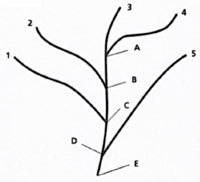
Which trait should go where A is on the cladogram?
eyes
feet
lips
hat
Tags
NGSS.MS-LS4-2


Access all questions and much more by creating a free account
Create resources
Host any resource
Get auto-graded reports

Continue with Google

Continue with Email

Continue with Classlink

Continue with Clever
or continue with

Microsoft
%20(1).png)
Apple

Others
Already have an account?
Similar Resources on Wayground
19 questions
Protists and Fungi Progress Check
Quiz
•
9th Grade - University
20 questions
Osmosis
Quiz
•
9th - 12th Grade
20 questions
Molecular Transport
Quiz
•
9th Grade
17 questions
Ecology Cycles Webquest
Quiz
•
9th Grade
13 questions
The Ultimate AXOLOTL Quiz!
Quiz
•
2nd Grade - Professio...
20 questions
The Brain
Quiz
•
9th - 10th Grade
17 questions
4H Dog External Anatomy
Quiz
•
4th - 12th Grade
15 questions
Cell Respiration
Quiz
•
9th Grade
Popular Resources on Wayground
15 questions
Fractions on a Number Line
Quiz
•
3rd Grade
20 questions
Equivalent Fractions
Quiz
•
3rd Grade
25 questions
Multiplication Facts
Quiz
•
5th Grade
22 questions
fractions
Quiz
•
3rd Grade
20 questions
Main Idea and Details
Quiz
•
5th Grade
20 questions
Context Clues
Quiz
•
6th Grade
15 questions
Equivalent Fractions
Quiz
•
4th Grade
20 questions
Figurative Language Review
Quiz
•
6th Grade
Discover more resources for Biology
20 questions
Cell Organelles
Quiz
•
9th Grade
20 questions
DNA & Protein Synthesis
Quiz
•
9th Grade
7 questions
Amoeba Sisters Dihybrid Cross Punnett Square

Interactive video
•
9th - 12th Grade
25 questions
photosynthesis and cellular respiration
Quiz
•
9th Grade
20 questions
Human Body Systems
Quiz
•
9th Grade
19 questions
Natural Selection
Quiz
•
9th Grade
20 questions
Pedigree Practice
Quiz
•
9th Grade
10 questions
Comparing Mitosis and Meiosis: Key Differences and Stages
Interactive video
•
6th - 10th Grade