
Bio B BM Review
Authored by Anne Smith
Biology
9th - 12th Grade


AI Actions
Add similar questions
Adjust reading levels
Convert to real-world scenario
Translate activity
More...
Content View
Student View
5 questions
Show all answers
1.
MULTIPLE CHOICE QUESTION
1 min • 1 pt
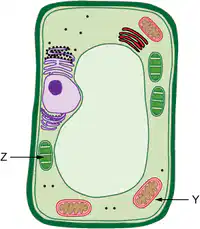
The diagram shows a cell.
Which statement BEST describes how the organelles labeled Y and Z work together to maintain homeostasis in the cell?
.
Organelle Y creates sugar and oxygen, which organelle Z uses to release energy.
Organelle Y does not create sugar and food, and organelle Z does not release energy for the cell.
Organelle Z creates sugar and oxygen, which organelle Y uses to release energy.
In the diagram, organelle Z represents the chloroplast, where photosynthesis occurs. Organelle Y represents a mitochondrion, which releases energy for the cell.
Organelle Y creates protein for food, which organelle Z uses to release energy.
Organelle Y does not create protein, and organelle Z does not release energy for the cell.
Organelle Z creates protein for food, which organelle Y uses to release energy.
Organelle Z does not create protein, and organelle Y does not release energy for the cell from protein.
2.
MULTIPLE CHOICE QUESTION
1 min • 1 pt
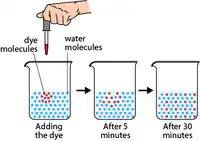
A student is investigating cellular transport. They fill a beaker with 250 ml of water. The student then places 10 drops of red food coloring into the beaker of water and makes an observation immediately, after 5 minutes, and after 30 minutes. The student's set up is shown. The student observes that the molecules of red dye move from an area of higher concentration to an area of lower concentration until equilibrium is reached. Which BEST describes the type of cellular transport that the student is investigating?
The student is investigating the active transport of diffusion.
Diffusion is a passive process, not an active process.
The student is investigating the active transport of osmosis.
Osmosis refers to the movement of water across a membrane, but there is no membrane in the investigation.
The student is investigating the passive transport of osmosis.
Osmosis refers to the movement of water across a membrane, but there is no membrane in the investigation.
The student is investigating the passive transport of diffusion.
Diffusion is the passive transport of molecules from areas of high concentration to areas of low concentration.
3.
MULTIPLE CHOICE QUESTION
1 min • 1 pt

The color of the petals in a carnation is determined by an incomplete dominance pattern. The Punnett square is used to determine the genotypes of the offspring of a homozygous red (RR) and a homozygous white (rr) carnation.
According to the Punnett square, what color of petals could result from the pairing of these plants?
only red flowers
A cross between RR and rr will produce 100% Rr genotypes. Since the red and white genes present incomplete dominance, they will blend together to produce 100% pink flowers, not red flowers.
only pink flowers
A cross between RR and rr will produce 100% Rr genotypes. Since the red and white genes present incomplete dominance, they will blend together to produce 100% pink flowers.
white and red flowers
A cross between RR and rr will produce 100% Rr genotypes. Since the red and white genes present incomplete dominance, they will blend together to produce 100% pink flowers, not white and red flowers.
red and pink flowers
A cross between RR and rr will produce 100% Rr genotypes. Since the red and white genes present incomplete dominance, they will blend together to produce 100% pink flowers, not red and pink flowers
4.
MULTIPLE CHOICE QUESTION
1 min • 1 pt
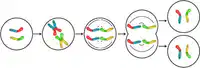
A student uses gummy worms to model the process of mitosis.
Using the model, which statement correctly explains how mitosis preserves genetic continuity?
The daughter cells receive chromosomes that are recombined from the parent cells.
The model shows one parent cell and two daughter cells. The chromosomes in the daughter cells are identical to the parent cell; they are not recombined. The identical chromosomes are represented by one red and blue gummy worm and one yellow and green gummy worm.
The daughter cells receive chromosomes that are identical to the parent cell.
The model shows the two daughter cells having identical chromosomes to the parent cell. The identical chromosomes are represented by one red and blue gummy worm and one yellow and green gummy worm.
Each daughter cell receives half of its chromosomes from each of the parent cells.
The model shows one parent cell and two daughter cells. The two daughter cells have the same number of chromosomes as their parent cell. This is represented by the two gummy worms in the parent cell, and the two gummy worms in the daughter cells.
Each daughter cell receives twice as many chromosomes as the parent cell.
The model shows the two daughter cells having the same number of chromosomes as their parent cell. This is represented by the two gummy worms in the parent cell, and the two gummy worms in the daughter cells.
5.
MULTIPLE SELECT QUESTION
1 min • 1 pt
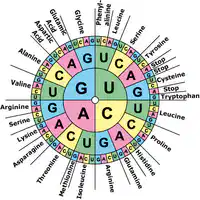
The chart shows how each mRNA codon corresponds to an amino acid.
Which TWO DNA codons code for aspartic acid?
CAG
The DNA codon CAG codes for the amino acid valine, not aspartic acid.
CTA
The mRNA codon GAU is complementary to the DNA codon CTA. Using the amino acid chart, it is determined that GAU codes for aspartic acid.
CTG
The mRNA codon GAC is complementary to the DNA codon CTG. Using the amino acid chart, it is determined that GAC codes for aspartic acid.
GAC
The DNA codon GAC codes for leucine, not aspartic acid.
GAU
DNA does not contain the nucleotide uracil.
Access all questions and much more by creating a free account
Create resources
Host any resource
Get auto-graded reports

Continue with Google

Continue with Email

Continue with Microsoft
or continue with

%20(1).png)
Apple

Others
Already have an account?

