
Angle Pairs
Authored by Brandy Smothers
Mathematics
Used 1+ times


AI Actions
Add similar questions
Adjust reading levels
Convert to real-world scenario
Translate activity
More...
Content View
Student View
20 questions
Show all answers
1.
MULTIPLE CHOICE QUESTION
2 mins • 1 pt
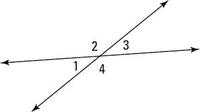
∠1 and ∠3 can best be described as -
complementary angles
linear pair
vertical angles
Answer explanation
The best description for ∠1 and ∠3 is 'vertical angles'. Vertical angles are pairs of opposite angles made by two intersecting lines. They are always equal.
2.
MULTIPLE CHOICE QUESTION
2 mins • 1 pt

∠a and ∠b can best be described as -
complementary angles
linear pair
vertical angles
Answer explanation
Angles a and b are complementary angles. Complementary angles are pairs of angles with measures that add to 90 degrees.
3.
MULTIPLE CHOICE QUESTION
2 mins • 1 pt

∠a and ∠b can best be described as
complementary angles
linear pair
vertical angles
Answer explanation
Angles a and b form a linear pair. A linear pair of angles are adjacent and supplementary. They are "built" along a line. Their measures add to 180 degrees.
4.
MULTIPLE CHOICE QUESTION
2 mins • 1 pt
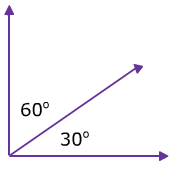
The angle relationship shown is -
complementary angles
linear pair
vertical angles
Answer explanation
The angle pair shown are complementary angles. This is because complementary angles, like the angles shown, have measures that add up to 90 degrees.
5.
MULTIPLE CHOICE QUESTION
3 mins • 2 pts
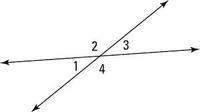
If m∠1 = 30°, then m∠3 =
30°
60°
150°
Answer explanation
Angles 1 and 3 are vertical angles, which means that their measures are equal (the same). So if angle 1 has a measure of 30 degrees, angle 3 also has a measure of 30 degrees.
6.
MULTIPLE CHOICE QUESTION
3 mins • 1 pt

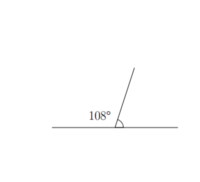
These angles ...
are complementary
are vertical angles
form a linear pair
Answer explanation
The angles shown form a linear pair since they are both adjacent, meaning they share a common side, and are supplementary, meaning their measures add up to 180 degrees.
7.
MULTIPLE CHOICE QUESTION
5 mins • 2 pts

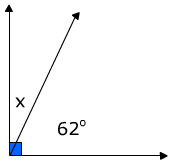
Find the missing angle.
40
50
140
Answer explanation
The missing angle in the question is 50 degrees. The angles shown are complementary angles, meaning their angles add up to 90 degrees. The equation would be
x+40=90.

Access all questions and much more by creating a free account
Create resources
Host any resource
Get auto-graded reports

Continue with Google

Continue with Email

Continue with Classlink

Continue with Clever
or continue with

Microsoft
%20(1).png)
Apple

Others
Already have an account?
Similar Resources on Wayground

15 questions
2D shapes

Quiz
•
3rd - 5th Grade
20 questions
Year 9 Unit 3
Quiz
•
8th Grade
15 questions
Math Vocabulary 1
Quiz
•
3rd Grade
20 questions
Year 10 Unit 10
Quiz
•
9th Grade
15 questions
Maths quiz grade 8
Quiz
•
8th Grade
20 questions
NATURALESA DEL FOC
Quiz
•
University
15 questions
Reviewer_ Ratio and Proportion
Quiz
•
6th Grade
20 questions
Class 7 Online Quiz 2
Quiz
•
7th Grade
Popular Resources on Wayground
15 questions
Fractions on a Number Line
Quiz
•
3rd Grade
20 questions
Equivalent Fractions
Quiz
•
3rd Grade
25 questions
Multiplication Facts
Quiz
•
5th Grade
54 questions
Analyzing Line Graphs & Tables
Quiz
•
4th Grade
22 questions
fractions
Quiz
•
3rd Grade
20 questions
Main Idea and Details
Quiz
•
5th Grade
20 questions
Context Clues
Quiz
•
6th Grade
15 questions
Equivalent Fractions
Quiz
•
4th Grade
Discover more resources for Mathematics
20 questions
Place Value
Quiz
•
KG - 3rd Grade
20 questions
Ch. 7 Quadrilateral Quiz Review
Quiz
•
KG - University
12 questions
Quarter Past, Half Past, and Quarter To
Quiz
•
KG - 12th Grade
10 questions
Subtraction to 10
Quiz
•
KG - 1st Grade
14 questions
superbowl 2026 trivia
Quiz
•
KG
30 questions
Comparing Greater Less and Equal
Quiz
•
KG
16 questions
Parallel, Perpendicular, and Intersecting Lines
Quiz
•
KG - Professional Dev...
15 questions
Comparing and Ordering Numbers
Quiz
•
KG - 1st Grade