
H-Evolution
Authored by Mallory Hoffman
Biology
9th - 12th Grade
Used 2+ times


AI Actions
Add similar questions
Adjust reading levels
Convert to real-world scenario
Translate activity
More...
Content View
Student View
35 questions
Show all answers
1.
MULTIPLE CHOICE QUESTION
1 min • 1 pt
"Survival of the Fittest" where the better adapted organisms survive to pass traits along to offspring.
2.
MULTIPLE CHOICE QUESTION
1 min • 1 pt
Why are advantageous traits more likely to be passed onto offspring?
3.
MULTIPLE CHOICE QUESTION
30 sec • 1 pt
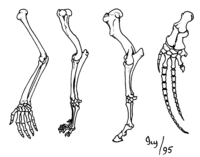
These structures with the same parts but different different functions suggest that organisms share a common ancestry.
4.
MULTIPLE CHOICE QUESTION
30 sec • 1 pt
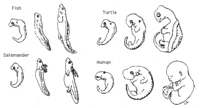
Study of embryos of various organisms to show a common ancestor because of similarities in development
5.
MULTIPLE CHOICE QUESTION
1 min • 1 pt

What type of structures are these?
6.
MULTIPLE CHOICE QUESTION
30 sec • 1 pt
Whales are aquatic mammals that contain a pelvis (hip) bone. Even though it does not aid in its movement, the function must have been used by a common ancestor of the whale. Thus, the pelvis is referred to as a(n)
vestigial structure
analogous structure
homologous structure
7.
MULTIPLE CHOICE QUESTION
30 sec • 1 pt
Genetic differences between organisms of the same species


Access all questions and much more by creating a free account
Create resources
Host any resource
Get auto-graded reports

Continue with Google

Continue with Email

Continue with Classlink

Continue with Clever
or continue with

Microsoft
%20(1).png)
Apple

Others
Already have an account?
Similar Resources on Wayground

35 questions
Pathogens

Quiz
•
11th - 12th Grade
40 questions
Animal Skeletal System Review
Quiz
•
10th - 12th Grade
34 questions
Unit 2 Biology
Quiz
•
10th - 12th Grade
40 questions
ecosystem and processes activate 2
Quiz
•
7th - 9th Grade
35 questions
Cell Membrane / Transportation
Quiz
•
10th - 11th Grade
35 questions
BSC Biology Year 9 Quiz
Quiz
•
9th Grade
35 questions
Missouri Biology EOC Reveiw
Quiz
•
9th - 10th Grade
37 questions
CSHS PreAP Biology - Unit 1 (Basics of Exploring Life)
Quiz
•
9th - 10th Grade
Popular Resources on Wayground
15 questions
Fractions on a Number Line
Quiz
•
3rd Grade
20 questions
Equivalent Fractions
Quiz
•
3rd Grade
25 questions
Multiplication Facts
Quiz
•
5th Grade
22 questions
fractions
Quiz
•
3rd Grade
20 questions
Main Idea and Details
Quiz
•
5th Grade
20 questions
Context Clues
Quiz
•
6th Grade
15 questions
Equivalent Fractions
Quiz
•
4th Grade
20 questions
Figurative Language Review
Quiz
•
6th Grade
Discover more resources for Biology
20 questions
Cell Organelles
Quiz
•
10th Grade
20 questions
Cell Organelles
Quiz
•
9th Grade
20 questions
DNA & Protein Synthesis
Quiz
•
9th Grade
7 questions
Amoeba Sisters Dihybrid Cross Punnett Square

Interactive video
•
9th - 12th Grade
25 questions
photosynthesis and cellular respiration
Quiz
•
9th Grade
20 questions
Human Body Systems
Quiz
•
9th Grade
19 questions
Natural Selection
Quiz
•
9th Grade
20 questions
Pedigree Practice
Quiz
•
9th Grade