
Fast and the Curious - Forces and Motion
Authored by Jeremy Jorgensen
Physics
5th Grade
NGSS covered
Used 31+ times


AI Actions
Add similar questions
Adjust reading levels
Convert to real-world scenario
Translate activity
More...
Content View
Student View
26 questions
Show all answers
1.
MULTIPLE CHOICE QUESTION
30 sec • 1 pt
Law of Inertia is
Newton's 1st law
Newton's 2nd law
Newton's 3rd law
Law of conservation of momentum
Answer explanation
The Law of Inertia is Newton's 1st law, which states that an object at rest will stay at rest, and an object in motion will stay in motion unless acted upon by an external force.
2.
MULTIPLE CHOICE QUESTION
30 sec • 1 pt
"For every action, there is an equal and opposite reaction" represents
Newton's 1st law
Newton's 2nd law
Newton's 3rd law
Law of conservation of momentum
Answer explanation
The statement 'For every action, there is an equal and opposite reaction' represents Newton's 3rd law, which states that every action has an equal and opposite reaction force.
3.
MULTIPLE CHOICE QUESTION
30 sec • 1 pt
F=ma represents
Newton's 1st law
Newton's 2nd law
Newton's 3rd law
Law of conservation of momentum
Answer explanation
The equation F=ma represents Newton's 2nd law, which states that the force acting on an object is equal to the mass of the object multiplied by its acceleration.
Tags
NGSS.HS-PS2-1
4.
MULTIPLE CHOICE QUESTION
30 sec • 1 pt
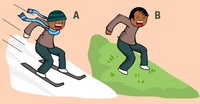
Why is it harder for the boy in Image B to get down the hill?
Motion
Friction
Work
Displacement
Answer explanation
Friction is the force that opposes the motion of the boy in Image B, making it harder for him to get down the hill.
5.
MULTIPLE CHOICE QUESTION
1 min • 1 pt
F = mass * acceleration
A 20 kg bike accelerates at 10 m/s2. What is the force acting upon it?
25 Newtons
20 Newtons
200 Newtons
10 Newtons
Answer explanation
The force acting upon the bike is calculated by multiplying the mass (20 kg) by the acceleration (10 m/s^2), resulting in 200 Newtons. Therefore, the correct answer is 200 Newtons.
Tags
NGSS.HS-PS2-1
6.
MULTIPLE CHOICE QUESTION
30 sec • 1 pt
When you hit a tennis ball with a racket...
The ball exerts more force on the racket
The ball and racket exert the same force on each other
The racket exerts more force on the ball
It depends on how hard you hit it
Answer explanation
When you hit a tennis ball with a racket, the ball and racket exert the same force on each other according to Newton's third law of motion.
Tags
NGSS.HS-PS2-1
7.
MULTIPLE CHOICE QUESTION
30 sec • 1 pt
The rate that a car's velocity changes is its
speed
force
gravity
acceleration
Answer explanation
The rate that a car's velocity changes is known as acceleration, not speed, force, or gravity.
Tags
NGSS.HS-PS2-1
Access all questions and much more by creating a free account
Create resources
Host any resource
Get auto-graded reports

Continue with Google

Continue with Email

Continue with Classlink

Continue with Clever
or continue with

Microsoft
%20(1).png)
Apple

Others
Already have an account?



