
TEK 9A*
Authored by Julie Edwards
Biology
8th Grade
NGSS covered


AI Actions
Add similar questions
Adjust reading levels
Convert to real-world scenario
Translate activity
More...
Content View
Student View
19 questions
Show all answers
1.
MULTIPLE CHOICE QUESTION
30 sec • 1 pt
When something is similar in function to something else, we refer to it as ___________.
vestigial
homologous
extinct
dormant
Tags
NGSS.MS-LS4-2
2.
MULTIPLE CHOICE QUESTION
30 sec • 1 pt
If something continues to exist without retaining its original function, it is considered to be ___________.
vestigial
homologous
useful
extinct
Tags
NGSS.MS-LS4-2
3.
MULTIPLE CHOICE QUESTION
30 sec • 1 pt

What can we conclude from the similarities in the baleen whale and hummingbird skeletons?
The whale could fly at one time.
The hummingbird could once swim.
Both animals evolved from a common ancestor.
There is nothing to conclude because they are so different.
Tags
NGSS.MS-LS4-2
4.
MULTIPLE CHOICE QUESTION
30 sec • 1 pt

Which statement can be best supported by the pictures of the embryos.
Chickens are more closely related to tortoises than rabbits are.
Rabbits, chickens, tortoises, and fish are all equally related to each another.
Fish do NOT share a common ancestor with other vertebrates.
Fish and chicken are the least closely related.
Tags
NGSS.MS-LS4-2
NGSS.MS-LS4-3
5.
MULTIPLE CHOICE QUESTION
30 sec • 1 pt
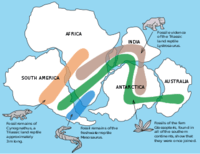
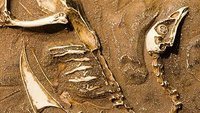
A ___________ is the trace, or remains, of an organism, usually found in sedimentary rock.
fossil
index fossil
dinosaur
chicken
Tags
NGSS.MS-LS4-1
6.
MULTIPLE CHOICE QUESTION
30 sec • 1 pt

The limbs of several organisms are shown in the illustrations below. Scientists sometimes compare the limbs of these organisms to look for evidence of common ancestry. These limbs provide evidence of common ancestry because they -
have the same basic structure
perform the same function
are the same size
are parts of mammals
Tags
NGSS.MS-LS4-2
7.
MULTIPLE CHOICE QUESTION
30 sec • 1 pt

The idea that similar DNA or Amino Acid Sequences indicate common evolutionary ancestry
Molecular Homology (DNA)
Anatomical Homology
Developmental Homology
all of the above
Tags
NGSS.MS-LS3-1
NGSS.MS-LS4-4

Access all questions and much more by creating a free account
Create resources
Host any resource
Get auto-graded reports

Continue with Google

Continue with Email

Continue with Classlink

Continue with Clever
or continue with

Microsoft
%20(1).png)
Apple

Others
Already have an account?
Similar Resources on Wayground

20 questions
Tropisms Pretest

Quiz
•
6th - 8th Grade
14 questions
how plants grow
Quiz
•
8th Grade
14 questions
Photosynthesis Inputs & Outputs
Quiz
•
6th - 10th Grade
14 questions
Practice quiz Seeds and plants
Quiz
•
7th - 10th Grade
17 questions
Levels of Organization and Digestion
Quiz
•
8th - 12th Grade
22 questions
Revision Quiz/Grade 8
Quiz
•
6th - 8th Grade
15 questions
Exploring Nutrition Systems in Humans and Animals
Quiz
•
7th Grade - University
16 questions
Terms and definitions - diseases
Quiz
•
6th - 12th Grade
Popular Resources on Wayground
15 questions
Fractions on a Number Line
Quiz
•
3rd Grade
20 questions
Equivalent Fractions
Quiz
•
3rd Grade
25 questions
Multiplication Facts
Quiz
•
5th Grade
22 questions
fractions
Quiz
•
3rd Grade
20 questions
Main Idea and Details
Quiz
•
5th Grade
20 questions
Context Clues
Quiz
•
6th Grade
15 questions
Equivalent Fractions
Quiz
•
4th Grade
20 questions
Figurative Language Review
Quiz
•
6th Grade
Discover more resources for Biology
10 questions
Comparing Mitosis and Meiosis: Key Differences and Stages

Interactive video
•
6th - 10th Grade
20 questions
cell theory and organelles
Quiz
•
6th - 8th Grade
14 questions
Reading Comprehension SC.7.L.15.1

Passage
•
8th Grade
10 questions
Cell Structure and Function Concepts
Interactive video
•
6th - 10th Grade
10 questions
Natural Selection and Adaptation in Evolution
Interactive video
•
6th - 10th Grade
15 questions
Pedigrees
Quiz
•
7th - 12th Grade
10 questions
Cellular Respiration
Quiz
•
7th - 8th Grade
27 questions
Ecological relationships
Quiz
•
8th - 10th Grade