
Ecosystems: Cycling of Matter and Flow of Energy
Authored by TYRELLE BANKSTON
Biology
7th Grade


AI Actions
Add similar questions
Adjust reading levels
Convert to real-world scenario
Translate activity
More...
Content View
Student View
8 questions
Show all answers
1.
MULTIPLE CHOICE QUESTION
30 sec • 1 pt
Which components are involved in the cycling of matter and flow of energy in an ecosystem?
Abiotic components only
Neither biotic nor abiotic components
Biotic components only
Both biotic and abiotic components
Answer explanation
The correct answer is both biotic and abiotic components because they are both involved in the cycling of matter and flow of energy in an ecosystem.
2.
MULTIPLE CHOICE QUESTION
30 sec • 1 pt
What is the primary source of energy for most ecosystems?
Wind
Water
The Sun
Geothermal heat
Answer explanation
The primary source of energy for most ecosystems is the Sun, as it provides light and heat necessary for photosynthesis and drives the food chain.
3.
MULTIPLE CHOICE QUESTION
30 sec • 1 pt
Which of the following best describes energy flow in an ecosystem?
Energy flows in a linear path from producers to consumers
Energy is recycled within an ecosystem, similar to matter
Energy flows in a circular path, returning to the sun
Energy flows in one direction, from the sun to producers and then to various levels of consumers
Answer explanation
Energy flows in one direction, from the sun to producers and then to various levels of consumers
4.
MULTIPLE CHOICE QUESTION
30 sec • 1 pt
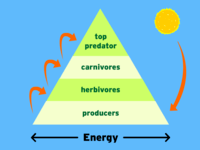
In the energy pyramid below, which organism has the least amount of energy available?
Producers
Herbivores
Carnivores
Top Predator
Answer explanation
The Top Predator has the least amount of energy available in the energy pyramid as energy is lost as it moves up the food chain.
5.
MULTIPLE CHOICE QUESTION
30 sec • 1 pt
In an ecosystem, primary consumers are also known as:
Herbivores
Carnivores
Omnivores
Decomposers
Answer explanation
Primary consumers in an ecosystem are also known as herbivores, as they primarily feed on plants.
6.
MULTIPLE CHOICE QUESTION
30 sec • 1 pt
What role do decomposers play in an ecosystem?
They produce their own food through photosynthesis
They consume living plants and animals
They break down dead material and recycle nutrients back into the ecosystem
They regulate the population of other species
Answer explanation
Decomposers play a crucial role in an ecosystem by breaking down dead material and recycling nutrients back into the ecosystem.
7.
MULTIPLE CHOICE QUESTION
30 sec • 1 pt
Animals and plants use aerobic cellular respiration to release energy for biological processes, CO2 is release. What is this process called?
macromolecules
combustion
cellular respiration
photosynthesis
Answer explanation
The correct process where CO2 is released during the release of energy through aerobic cellular respiration is called cellular respiration.
Access all questions and much more by creating a free account
Create resources
Host any resource
Get auto-graded reports

Continue with Google

Continue with Email

Continue with Classlink

Continue with Clever
or continue with

Microsoft
%20(1).png)
Apple

Others
Already have an account?



