
BIO EOC - Mitosis & Meiosis (Pages 8-9)
Authored by Kathryn Tiling
Biology
9th - 12th Grade
NGSS covered
Used 2+ times


AI Actions
Add similar questions
Adjust reading levels
Convert to real-world scenario
Translate activity
More...
Content View
Student View
45 questions
Show all answers
1.
MULTIPLE CHOICE QUESTION
5 mins • 1 pt
At what point in the cell cycle does DNA replication occur and why?
Tags
NGSS.HS-LS1-4
2.
MULTIPLE CHOICE QUESTION
5 mins • 1 pt
Oncogenes are mutated forms of genes. Oncogenes can transform a cell into a tumor cell. Some tumor cells are benign, while others are malignant. How does the presence of an oncogene lead to the formation of a tumor?
ATP production is inhibited.
Cell division is unregulated.
Somatic cell growth is inhibited.
Antibody activity is unregulated.
Tags
NGSS.HS-LS3-2
3.
MULTIPLE CHOICE QUESTION
5 mins • 1 pt

When cells leave the cell cycle, they exit during G1 phase and then enter G0 phase, a resting period. Most normal cells leave G0 phase and reenter the cell cycle at G1 phase before entering S phase. Cancer cells are different because that cannot enter G0 phase and are likely to do which of the following?
Fail to complete S phase
Mutate during G1 phase
Repeat the cell cycle continuously
Die after completing mitosis
4.
MULTIPLE CHOICE QUESTION
5 mins • 1 pt
Which of the following describes cancer?
Tags
NGSS.HS-LS3-2
5.
MULTIPLE CHOICE QUESTION
5 mins • 1 pt

In mitosis, the two resulting cells are
Tags
NGSS.HS-LS1-4
6.
MULTIPLE CHOICE QUESTION
5 mins • 1 pt
If there are 20 chromosomes in the nucleus before mitosis how many will there be in each new daughter cell after cytokinesis?
20
10
40
200
Tags
NGSS.HS-LS1-4
7.
MULTIPLE CHOICE QUESTION
5 mins • 1 pt
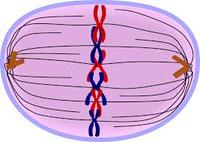
Put the stages of mitosis in the correct order.
Tags
NGSS.HS-LS1-4

Access all questions and much more by creating a free account
Create resources
Host any resource
Get auto-graded reports

Continue with Google

Continue with Email

Continue with Classlink

Continue with Clever
or continue with

Microsoft
%20(1).png)
Apple

Others
Already have an account?
Similar Resources on Wayground

50 questions
Unit 7: Marine Conservation Review Practice Quiz

Quiz
•
9th - 12th Grade
50 questions
Male vs Female Reproductive Sys Qs
Quiz
•
9th - 11th Grade
50 questions
Protein Translation
Quiz
•
9th - 12th Grade
45 questions
Biochemistry
Quiz
•
KG - University
40 questions
DNA structure and Cell Cycle
Quiz
•
8th - 9th Grade
43 questions
Phylum Mollusca
Quiz
•
9th - 12th Grade
40 questions
Biomolecules Review!
Quiz
•
9th - 10th Grade
40 questions
DNA and Protein Synthesis
Quiz
•
10th - 11th Grade
Popular Resources on Wayground
15 questions
Fractions on a Number Line
Quiz
•
3rd Grade
20 questions
Equivalent Fractions
Quiz
•
3rd Grade
25 questions
Multiplication Facts
Quiz
•
5th Grade
54 questions
Analyzing Line Graphs & Tables
Quiz
•
4th Grade
22 questions
fractions
Quiz
•
3rd Grade
20 questions
Main Idea and Details
Quiz
•
5th Grade
20 questions
Context Clues
Quiz
•
6th Grade
15 questions
Equivalent Fractions
Quiz
•
4th Grade
Discover more resources for Biology
20 questions
Cell Organelles
Quiz
•
9th Grade
14 questions
Ecological Succession: Primary and Secondary
Quiz
•
9th Grade
22 questions
Human Body Systems Overview
Quiz
•
9th Grade
25 questions
photosynthesis and cellular respiration
Quiz
•
9th Grade
21 questions
Meiosis Vs Mitosis
Quiz
•
10th Grade
10 questions
Comparing Mitosis and Meiosis: Key Differences and Stages

Interactive video
•
6th - 10th Grade
13 questions
Amoeba Sisters Viruses Video quiz
Interactive video
•
9th Grade
20 questions
Cladogram Practice
Quiz
•
10th Grade