
Unit 6 Chemistry Review
Authored by Shakhzod Abdishukurov
Chemistry
10th Grade
NGSS covered
Used 3+ times


AI Actions
Add similar questions
Adjust reading levels
Convert to real-world scenario
Translate activity
More...
Content View
Student View
10 questions
Show all answers
1.
MULTIPLE CHOICE QUESTION
30 sec • 1 pt
Which of the following is an exothermic process?
Melting Ice
Eating Food
Cooking Eggs
Photosynthesis
Tags
NGSS.HS-PS3-1
NGSS.HS-PS1-4
2.
MULTIPLE CHOICE QUESTION
30 sec • 1 pt
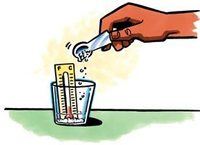
In an endothermic reaction, heat is...
taken in or absorbed
given out or released
Tags
NGSS.HS-PS1-4
3.
MULTIPLE CHOICE QUESTION
30 sec • 1 pt
In an exothermic reaction, how does the heat flow?
From the surroundings to the system
From the system to the surroundings
Within the system only
No heat flow occurs
Tags
NGSS.HS-PS3-4
4.
MULTIPLE CHOICE QUESTION
30 sec • 1 pt
The specific heat is defined as:
The heat required to raise the temperature of 1 g of a substance by 1°C
The heat released when a substance changes phase
The rate at which a chemical reaction occurs by 1°C
a set amount of heat that is used to create chemical changes
Tags
NGSS.HS-PS3-4
5.
MULTIPLE CHOICE QUESTION
30 sec • 1 pt
Calculate the heat required to raise 500 g of water from 20°C to 80°C (specific heat of water = 4.18 J/g°C):
a) 12540
b) 125400 J
c) 1254
d) 2090 J
Tags
NGSS.HS-PS3-1
6.
MULTIPLE CHOICE QUESTION
30 sec • 1 pt

On the heating curve, the flat sections represent...?
Solid phase
Liquid phase
Gas phase
Phase changes
Tags
NGSS.MS-PS1-4
7.
MULTIPLE CHOICE QUESTION
30 sec • 1 pt
How much heat is required to vaporize 100 g of water at 100°C? (Heat of vap = 2260 J/g)
22,600 J
226,000 J
2,260 J
4,520 J
Tags
NGSS.HS-PS3-1
Access all questions and much more by creating a free account
Create resources
Host any resource
Get auto-graded reports

Continue with Google

Continue with Email

Continue with Classlink

Continue with Clever
or continue with

Microsoft
%20(1).png)
Apple

Others
Already have an account?



