
Series and Parallel Circuits
10th - 12th Grade
•11 Qs

Similar activities
10.2 - Applying Magnetic Forces
10th Grade
•10 Qs
Tugas Persiapan PAS Fisika
12th Grade
•15 Qs
force and pressure
9th - 10th Grade
•15 Qs
Astro IGCSE
10th - 12th Grade
•16 Qs
MCAS Engineering Design
9th - 12th Grade
•15 Qs
CP10-11
9th - 11th Grade
•15 Qs
DESIGN OF THERMOMETERS
11th - 12th Grade
•10 Qs
6.6 image formation by spherical mirrors F4
10th Grade
•11 Qs
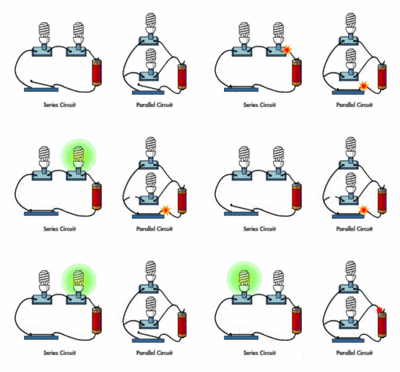
Series and Parallel Circuits

Quiz
•
Physics
•
10th - 12th Grade
•
Practice Problem
•
Hard
+2
Standards-aligned

Rasha al-ruz
Used 1K+ times
FREE Resource

Enhance your content in a minute
11 questions
Show all answers
1.
MULTIPLE CHOICE QUESTION
45 sec • 1 pt
Four unequal resistors are connected in series with each other. Which one of the following statements is correct about this combination?
The equivalent resistance is equal to that of any one of the resistors.
The equivalent resistance is equal to average of the four resistances.
The equivalent resistance is less than that of the smallest resistor.
The equivalent resistance is less than that of the largest resistor.
The equivalent resistance is more than the largest resistance.
2.
MULTIPLE CHOICE QUESTION
1 min • 1 pt
Four unequal resistors are connected in a parallel with each other. Which one of the following statements is correct about this combination?
The equivalent resistance is less than that of the smallest resistor.
The equivalent resistance is equal to the average of the four resistances.
The equivalent resistance is midway between the largest and smallest resistance.
The equivalent resistance is more than the largest resistance.
None of the other choices is correct.
3.
MULTIPLE CHOICE QUESTION
1 min • 1 pt
Draw a circuit with a battery connected to four resistors, R1, R2, R3, and R4, as follows. Resistors R1 and R2 are connected in parallel with each other, resistors R3 and R4 are connected in parallel with each other, and both parallel sets of resistors are connected in series with each other across the battery.


Tags
NGSS.HS-PS3-3
4.
MULTIPLE CHOICE QUESTION
1 min • 1 pt
When unequal resistors are connected in parallel in a circuit,
the same current always runs through each resistor.
the potential drop is always the same across each resistor.
the largest resistance has the largest current through it.
the power generated in each resistor is the same.
5.
MULTIPLE CHOICE QUESTION
1 min • 1 pt
When unequal resistors are connected in series across an ideal battery,
the same power is dissipated in each one.
the potential difference across each is the same.
the current flowing in each is the same.
the equivalent resistance of the circuit is less than that of the smallest resistor.
the equivalent resistance of the circuit is equal to the average of all the resistances.
Tags
NGSS.HS-PS2-5
6.
MULTIPLE CHOICE QUESTION
1 min • 1 pt
As more resistors are added in series to a constant voltage source, the power supplied by the source
increases.
decreases.
does not change.
increases for a time and then starts to decrease.
7.
MULTIPLE CHOICE QUESTION
1 min • 1 pt
As more resistors are added in parallel across a constant voltage source, the power supplied by the source
increases.
decreases.
does not change.
increases for a time and then starts to decrease.


Access all questions and much more by creating a free account
Create resources
Host any resource
Get auto-graded reports

Continue with Google

Continue with Email

Continue with Classlink

Continue with Clever
or continue with

Microsoft
%20(1).png)
Apple

Others
Already have an account?
Similar Resources on Wayground
10 questions
หน่วยและการวัด
Quiz
•
10th - 11th Grade
13 questions
MECHANICAL: Physics Equations on energy, work and power
Quiz
•
7th - 10th Grade
10 questions
EM Waves
Quiz
•
7th - 10th Grade
10 questions
Particle and nuclear Physics (AS Physics)
Quiz
•
12th Grade
12 questions
DIODE - HALF WAVE AND FULL WAVE RECTIFICATION
Quiz
•
11th - 12th Grade
15 questions
Magnetism and magnetic effect
Quiz
•
12th Grade
10 questions
What is CURRENT?/Conventional Current vs. Electron Flow
Quiz
•
12th Grade
10 questions
Review Quiz
Quiz
•
10th Grade
Popular Resources on Wayground
15 questions
Fractions on a Number Line
Quiz
•
3rd Grade
20 questions
Equivalent Fractions
Quiz
•
3rd Grade
25 questions
Multiplication Facts
Quiz
•
5th Grade
54 questions
Analyzing Line Graphs & Tables
Quiz
•
4th Grade
22 questions
fractions
Quiz
•
3rd Grade
20 questions
Main Idea and Details
Quiz
•
5th Grade
20 questions
Context Clues
Quiz
•
6th Grade
15 questions
Equivalent Fractions
Quiz
•
4th Grade
Discover more resources for Physics
16 questions
Coulomb's Law
Quiz
•
11th Grade
10 questions
Understanding Heat, Thermal Energy, and Temperature

Interactive video
•
9th - 10th Grade
10 questions
Newton's Laws of Motion
Quiz
•
10th Grade
10 questions
unit 10 -- electric forces and fields

Lesson
•
9th - 12th Grade
21 questions
Diffraction, Reflection, Refraction
Quiz
•
9th - 12th Grade
15 questions
Position vs. Time and Velocity vs. Time Graphs
Quiz
•
10th - 12th Grade
10 questions
Types of Chemical Reactions
Quiz
•
10th Grade
11 questions
Conservation of Momentum: Physics in Motion Video
Interactive video
•
10th Grade