
WAVES Revision
Authored by Mari Bartholomae
Physics
10th Grade
Used 2+ times


AI Actions
Add similar questions
Adjust reading levels
Convert to real-world scenario
Translate activity
More...
Content View
Student View
35 questions
Show all answers
1.
MULTIPLE CHOICE QUESTION
30 sec • 1 pt
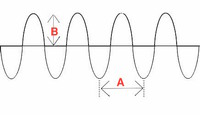
What property of the wave is represented by the letter "B"?
amplitude
crest
trough
wavelength
Answer explanation
The property of the wave represented by the letter 'B' is the amplitude, which is the maximum displacement of the wave from its equilibrium position.
2.
MULTIPLE CHOICE QUESTION
30 sec • 1 pt
The number of wavelengths that pass a point each per second is:
frequency
period
longitudinal
transverse wave
Answer explanation
The correct choice is frequency because it represents the number of wavelengths passing a point per second.
3.
MULTIPLE CHOICE QUESTION
30 sec • 1 pt
When the frequency of a wave increases, what happens to the wavelength?
The wavelength is not directly affected by the frequency of a wave.
The wavelength increases.
The wavelength decreases.
More specific information is needed to form a conclusion about the wavelength.
Answer explanation
When the frequency of a wave increases, the wavelength decreases. This is an inverse relationship described by the wave equation.
4.
MULTIPLE CHOICE QUESTION
30 sec • 1 pt
A mechanical wave cannot travel through...
a vacuum(empty space).
water.
air.
glass.
Answer explanation
A mechanical wave cannot travel through a vacuum (empty space) because it requires a medium to propagate, and a vacuum lacks particles for the wave to interact with.
5.
MULTIPLE CHOICE QUESTION
30 sec • 1 pt
which material does sound travel the fastest?
solid
liquid
gases
Answer explanation
Sound travels the fastest in solids because the particles are closer together, allowing the sound waves to travel more efficiently.
6.
MULTIPLE CHOICE QUESTION
30 sec • 1 pt
When a wave strikes and object and bounces off. (example echo)
medium
refraction
reflection
interference
Answer explanation
When a wave strikes an object and bounces off, it is known as reflection. This is similar to an echo where the sound wave reflects off a surface.
7.
MULTIPLE CHOICE QUESTION
30 sec • 1 pt
In a longitudinal wave, the particles move...?
back and forth
up and down
vertically
in the direction of the hertz
Answer explanation
In a longitudinal wave, the particles move back and forth.

Access all questions and much more by creating a free account
Create resources
Host any resource
Get auto-graded reports

Continue with Google

Continue with Email

Continue with Microsoft
or continue with

%20(1).png)
Apple

Others
Already have an account?

