
2024 2nd semester 2/3
Authored by Melvin Richendollar
Science
9th Grade
NGSS covered
Used 29+ times


AI Actions
Add similar questions
Adjust reading levels
Convert to real-world scenario
Translate activity
More...
Content View
Student View
23 questions
Show all answers
1.
MULTIPLE CHOICE QUESTION
30 sec • 1 pt
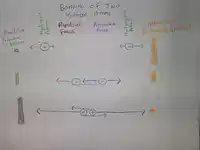
Any two atoms trying to form a chemical bond must be close to a balance position to form a bond. This diagram shows the two atoms too far apart, just right (balanced), and too close.
Using the diagram below of two hydrogen atoms what is the most stable electron arrangement in terms of attractive and repulsive forces that make up the chemical bond ?
When the electron cloud has very little attraction due to it's decreased density. This will allow for a bigger repulsive force between the positive nuclei than an attractive force between the electron cloud and the positive nuclei of the adjacent atom. This is a stable chemical bond.
When the electron cloud has a strong attraction due to it's increased density. This will allow for a smaller repulsive force between the positive nuclei than an attractive force between the electron cloud and the positive nuclei of the adjacent atom. This is a stable chemical bond.
When the electron cloud has a strong attraction due to it's increased density. This distance needs to be such that the repulsive force between the positive nuclei must equal attractive force between the electron cloud and the positive nuclei of the adjacent atom. This is a stable chemical bond.
Tags
NGSS.HS-PS1-2
2.
MULTIPLE CHOICE QUESTION
30 sec • 1 pt
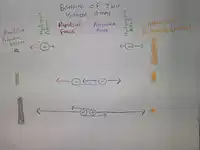
Any two atoms trying to form a chemical bond must be close to a balance position to form a bond. This diagram shows the two atoms too far apart, just right (balanced), and too close.
Using the diagram below of two hydrogen atoms what is the most stable arrangement in terms of energy ?
When the repulsive forces equal the attractive forces because this has a maximum potential energy for the bond.
When the repulsive forces equal the attractive forces because this has a minimum potential energy compared to other arrangements .
When the repulsive forces equal the attractive forces because this has no potential energy.
Tags
NGSS.HS-PS1-4
3.
MULTIPLE CHOICE QUESTION
30 sec • 1 pt
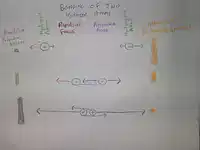
Any two atoms trying to form a chemical bond must be close to a balance position to form a bond. This diagram shows the two atoms too far apart, just right (balanced), and too close.
Using the diagram below of two hydrogen atoms what is the pattern of the attractive potential energy and attractive force that best describes the interactions.
Attractive potential energy is low the further away the two atoms are and then the closer they are the more attractive potential energy they have. Additionally, The attractive force is large the further away the the two atoms are and the force decreases the closer they are.
Attractive potential energy is high the further away the two atoms are and then the closer they are the less attractive potential energy they have. Additionally, The attractive force is small the further away the the two atoms are and the force increases the closer they are.
Tags
NGSS.HS-PS1-3
4.
MULTIPLE CHOICE QUESTION
30 sec • 1 pt

Compare H-H and He-He bonds below. Which is one has the greatest chance of forming a chemical bond and why ?
He-He because the individual atoms potential energy is a lot greater than the molecules potential energy. By sharing electrons it becomes more stable do to the decrease in potential energy.
He-He because there is not that much difference in the potential energy of the individual atoms and the molecule they would form.
H-H Because it has very little binding energy
H-H because the individual atoms potential energy is a lot greater than the hydrogen H2molecule's potential energy. By sharing electrons it becomes more stable due to the decrease in potential energy.
Tags
NGSS.HS-PS1-4
NGSS.HS-PS1-2
5.
MULTIPLE CHOICE QUESTION
30 sec • 1 pt
To get a hydrogen molecule H2 to break the bond that holds the two hydrogens together we need to do this
The hydrogen molecule H2 bond can be broken by using a third atom with a lot of kinetic energy and force a collision or simply increase the temperature.
Increase the kinetic energy of the hydrogen atoms to force the bond that makes the molecule H2
Increase the potential energy of the atoms that form the molecule
Tags
NGSS.HS-PS1-5
6.
MULTIPLE CHOICE QUESTION
30 sec • 1 pt
In order to break the bond between atoms in a molecule, what needs to happen?
A slow moving particle collides with the molecule and increases the potential and kinetic energy of the atoms.
A fast moving particle collides with the molecule and increases the potential and kinetic energy of the atoms.
A slow moving particle collides with the molecule and decreases the potential and kinetic energy of the atoms.
A fast moving particle collides with the molecule and decreases the potential and kinetic energy of the atoms.
Tags
NGSS.HS-PS1-5
7.
MULTIPLE CHOICE QUESTION
30 sec • 1 pt
How does the energy of the system change during an explosion?
The kinetic energy of the system increases because the bonds between atoms are broken causing potential energy to increase.
The kinetic energy of the system increases because the bonds between atoms are formed causing potential energy to decrease.
The kinetic energy of the system decreases because the bonds between atoms are broken causing potential energy to increase.
The kinetic energy of the system decreases because the bonds between atoms are formed causing potential energy to decrease.
Tags
NGSS.HS-PS1-4
Access all questions and much more by creating a free account
Create resources
Host any resource
Get auto-graded reports

Continue with Google

Continue with Email

Continue with Microsoft
or continue with

%20(1).png)
Apple

Others
By signing up, you agree to our Terms of Service & Privacy Policy
Already have an account?


