Sound and Light Waves

Sound and Light Waves

9th - 12th Grade

18 Qs

quiz-placeholder

Similar activities

EARTH MAGNETIC FIELDS

EARTH MAGNETIC FIELDS

9th Grade

18 Qs

2020 F5 SC C4: Soap,polymer&monomer,rubber

2020 F5 SC C4: Soap,polymer&monomer,rubber

11th Grade

14 Qs

REVIEW LESSON: Earth's Subsystem and Biochemical Cycle

REVIEW LESSON: Earth's Subsystem and Biochemical Cycle

11th Grade

20 Qs

quiz prelims

quiz prelims

9th - 12th Grade

20 Qs

Theories on the Origin of the Universe

Theories on the Origin of the Universe

11th Grade

15 Qs

Rock cycle/classification

Rock cycle/classification

11th Grade

15 Qs

Air, Respiration & Pollution

Air, Respiration & Pollution

8th - 9th Grade

15 Qs

Compounds: Formulas and Names

Compounds: Formulas and Names

12th Grade

20 Qs

Sound and Light Waves

Sound and Light Waves

Assessment

Quiz

Science

9th - 12th Grade

Medium

NGSS
MS-PS4-1, HS-PS4-1, MS-PS4-2

Standards-aligned

Created by

Alayna Nonhomme

Used 34+ times

FREE Resource

AI

Enhance your content in a minute

Add similar questions
Adjust reading levels
Convert to real-world scenario
Translate activity
More...

18 questions

Show all answers

1.

MULTIPLE CHOICE QUESTION

30 sec • 1 pt
Waves are a transfer of what?

Heat
Light
Energy
Food

Tags

NGSS.MS-PS4-1

2.

MULTIPLE CHOICE QUESTION

30 sec • 1 pt

Media Image

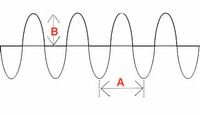
What property of this wave is represented by the letter "A"

amplitude
crest
trough
wavelength

Tags

NGSS.MS-PS4-1

3.

MULTIPLE CHOICE QUESTION

30 sec • 1 pt

The highest point on a wave is:

the crest
the trough
the top
the coast 

Tags

NGSS.MS-PS4-1

4.

MULTIPLE CHOICE QUESTION

30 sec • 1 pt

The lowest point on a wave is the:

Amplitude
Crest
Trough
Wavelength

5.

MULTIPLE CHOICE QUESTION

30 sec • 1 pt

The number of wavelengths that pass a point per second is:

frequency
period
longitudinal 
transverse wave 

6.

MULTIPLE CHOICE QUESTION

30 sec • 1 pt

The type of waves that require medium to pass:

Mechanical Waves
Electromagnetic Waves

7.

MULTIPLE CHOICE QUESTION

30 sec • 1 pt

When the frequency of a wave increases, what happens to the wavelength?

The wavelength is not directly affected by the frequency of a wave.
The wavelength increases.
The wavelength decreases.
More specific information is needed to form a conclusion about the wavelength.

Tags

NGSS.HS-PS4-1

Access all questions and much more by creating a free account

Create resources

Host any resource

Get auto-graded reports

Google

Continue with Google

Email

Continue with Email

Classlink

Continue with Classlink

Clever

Continue with Clever

or continue with

Microsoft

Microsoft

Apple

Apple

Others

Others

Already have an account?