
Unit 8 - Lesson 16 - Grade 8: Illustrative Mathematics
Authored by Wayground Content
Algebra I, Algebra II, Geometry, Math


AI Actions
Add similar questions
Adjust reading levels
Convert to real-world scenario
Translate activity
More...
Content View
Student View
3 questions
Show all answers
1.
OPEN ENDED QUESTION
3 mins • 1 pt
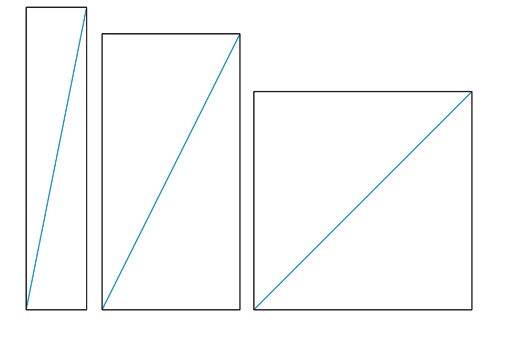
How are these shapes the same? How are they different?
Evaluate responses using AI:
OFF
2.
OPEN ENDED QUESTION
3 mins • 1 pt
What does it mean that the aspect ratio is 4 : 3? Mark up the diagram to show what that means.
Evaluate responses using AI:
OFF
3.
OPEN ENDED QUESTION
3 mins • 1 pt
Before 2017, a smart phone manufacturer’s phones had a diagonal length of 5.8 inches and an aspect ratio of 16 : 9. In 2017, they released a new phone that also had a 5.8-inch diagonal length, but an aspect ratio of 18.5 : 9. Some customers complained that the new phones had a smaller screen. Were they correct? If so, how much smaller was the new screen compared to the old screen?
Evaluate responses using AI:
OFF
Access all questions and much more by creating a free account
Create resources
Host any resource
Get auto-graded reports

Continue with Google

Continue with Email

Continue with Classlink

Continue with Clever
or continue with

Microsoft
%20(1).png)
Apple

Others
Already have an account?

